Mobile RV LP Gas Service Across Florida
Regulators, pigtails, lines, valves and cylinders. Every burner in the coach depends on one delivery pressure, which is why gas faults tend to arrive in groups.
If the furnace, the water heater and the refrigerator all start misbehaving in the same week, that is one part rather than three faults. Every gas appliance in a coach is sized around a single delivery pressure, so when the regulator drifts they all drift with it. The quickest check is the flame on a range burner: blue and sharp is right, yellow and lazy is not.
Why do several gas appliances fail at the same time?
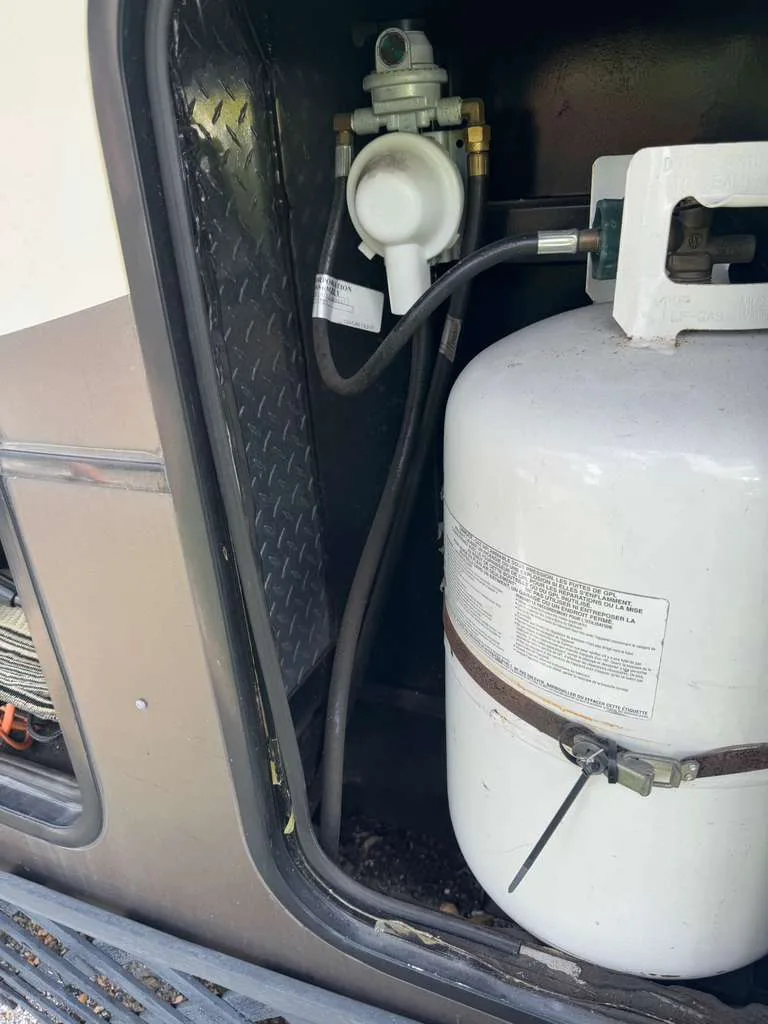
Because they share one regulator, and it is the only part in the system that every one of them depends on.
Pressure in a cylinder is not constant. It rises with temperature and falls as the cylinder empties, so a tank in the sun on a July afternoon and the same tank in January present very different conditions. The regulator's entire job is to hide that from the appliances.
Each burner is designed around one narrow delivery pressure. A small drift affects all of them, which is why the pattern to look for is breadth rather than severity.
One appliance misbehaving is that appliance. The range, the furnace and the fridge all misbehaving in the same week is the thing they share, and that is where we start. Diagnosing each appliance separately produces three quotes for one part, which is the outcome worth avoiding.
What does a yellow flame actually tell you?
That the gas and air mixture is wrong, which is the most direct evidence available anywhere in the system.
A correctly mixed propane flame burns blue with a small sharp inner cone. Yellow, soft, wavering flames mean the burner is not drawing the air it should for the gas arriving, and that is what happens when delivery pressure has drifted outside its window or an orifice is partly blocked.
The range is the best place to see it because the burners are visible and nothing sits between them and the supply. Lighting one and looking at it is genuinely diagnostic and takes seconds.
It matters for a second reason. Incomplete combustion produces carbon monoxide and soot, and on any appliance that vents into the coach that stops being a performance question. Any vented appliance burning yellow should be shut off rather than watched.
How is an RV propane system properly leak tested?
With a manometer on a test point and a timed pressure hold, not with soapy water alone.
Soap solution finds a leak you already suspect at a joint you can reach. It cannot tell you whether the system as a whole is tight, and most of an RV gas line runs where you cannot see or reach it.
A proper test pressurizes the system to a specified value with the cylinder valve closed, then watches the gauge for a defined period. A system that holds is tight. One that drops has a leak somewhere, and the size of the drop indicates roughly how large.
This is the test that follows any work on the gas side, including a water heater swap or a regulator change, and it is not optional. Our safety guide covers the same principle on the electrical side.
How long does a propane regulator last?
Roughly ten to fifteen years, measured from the date stamped on the body rather than from when the coach was bought.
Inside there is a spring, a rubber diaphragm and a valve seat. The diaphragm hardens with age and with temperature cycling, and that happens whether the coach travels constantly or sits in a storage lot, so low mileage is not protection.
Because these live in a bay nobody opens, it is common to find one well past that window on a coach that has otherwise been looked after carefully. The date is usually stamped near the inlet.
It is one of the few parts genuinely worth replacing on age alone, since it protects every gas appliance in the coach and costs very little relative to what it controls. Replacing one on age is far cheaper than the appliance calls a drifting regulator generates.
What is the vent on the regulator, and why does it matter?
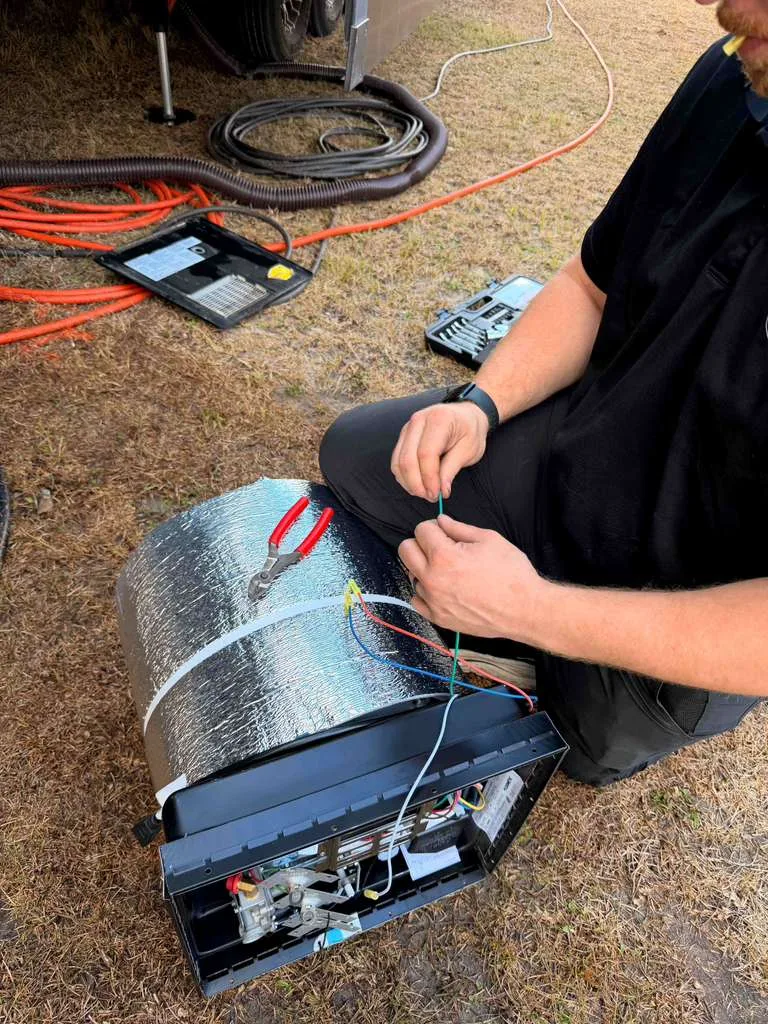
It is the small opening that lets the diaphragm move against atmospheric pressure, and a blocked one imitates a failed regulator exactly.
The vent has to point downward and stay clear. Water that gets in sits against the diaphragm, and on either Florida coast it brings salt with it that corrodes the spring and the seat over time.
Insects are the other local problem. A vent facing sideways or upward is an inviting hole, and a nest in it stops the diaphragm moving freely, which produces exactly the symptoms of a worn one.
The plastic cover over the regulator is not decoration for the same reason, and a coach found without one usually has a regulator aging faster than its date suggests. Replacing a missing cover is a few dollars and it is worth doing the day it goes missing rather than at the next service.
Do RV propane cylinders expire?
The DOT cylinders on travel trailers and fifth wheels do. The ASME tanks built into most motorhomes do not.
A removable DOT cylinder carries a manufacture date stamped on the collar and has to be requalified after a set period, then again at shorter intervals afterwards. A filling station will refuse an out-of-date cylinder, which is how most owners discover it.
The permanently mounted ASME tank on a motorhome is a different classification and does not carry the same requalification requirement, though its valves and fittings still age and still need inspecting.
The overfill protection valve on a DOT cylinder is its own component with its own service life, and a cylinder that will not fill properly is often reporting that valve rather than the cylinder. Checking the stamp before a trip avoids discovering it at a filling station a long way from home.
What should you do the moment you smell propane?
Leave, ventilate and shut the cylinder valve, in that order, and do not operate anything electrical on the way.
Propane is heavier than air, so it collects low in the coach - in the floor, under furniture, in the lowest bay. That is why a leak can be strong at ankle height and barely noticeable standing up, and why detectors are mounted near the floor.
Switches, lights and appliances all make small sparks when operated, so nothing should be turned on or off until the coach has been aired out with the gas isolated.
Once it is clear, the system needs a proper leak test before anything is lit again. A smell that goes away has not necessarily been fixed. A detector sounding with no smell is treated the same way, because the detector reaches concentrations a person does not.
What does Florida do to an LP system?
Humidity, salt and insects, and the insects cause more service calls here than anything mechanical.
Mud daubers build in the burner tubes of water heaters, furnaces and refrigerators, and they do it in a single season. A blocked tube produces a yellow flame, poor heat and a burner that lights and drops out, and it is entirely preventable with a screen.
Salt air corrodes regulator springs, pigtail fittings and valve threads on coaches kept near either coast. It is slow and it is invisible until a joint will not seal properly on reassembly.
Humidity does the rest, particularly on a coach stored for months. Our appliance service and this page overlap constantly, because most appliance faults here start on the gas side. A few dollars of insect screen prevents most of what we are called out for in March and April.
What Does Mobile RV LP Gas Service Cost?
These are typical ranges for mobile service across Florida. A brief description of what's included is in the Notes column.
| Service | Typical Range | Notes |
|---|---|---|
| Service call (trip + 1st hour diagnosis/labor) | $299 - $399 | All-in for getting us to your site + first hour on any job. Exact rate confirmed at booking; varies by location. |
| Regulator replacement (two-stage) | $95 - $240 | POL or ACME; includes leak test |
| LP leak test (full system) | $95 - $185 | Pressure-decay; certificate issued |
| Flex line / pigtail replacement | $75 - $185 | Per hose; appliance connections |
| Solenoid valve replacement | $110 - $320 | Auto LP shutoff; wiring checked |
| Appliance connection service (stove / furnace) | $85 - $195 | Per appliance; pressure verified |
| Full LP system inspection and retest | $185 - $380 | All lines, connections, and appliances |
Service call (trip charge + first hour) is $299-$399 depending on location - confirmed when you book. Repair line items below are national averages for mobile service (2025 data) and represent labor + parts after the first hour. Call (888) 702-6880 for an exact quote.
Propane questions RV owners ask us
Why does my fridge work on electric but not on propane?
Everything except the heat source is shared between the two modes, so a fault on one side only points at that side. On gas that is the burner, the orifice, the flue or the igniter, and a blocked burner tube is the most common of the four in this state.
Can I change a regulator myself?
The mechanical part is short, and the part that makes it a service job is what follows: every joint opened has to be pressure tested, and delivery pressure has to be set and confirmed against a gauge. Without that step you have a system that appears to work and has not been verified.
What is the changeover indicator on my regulator telling me?
That one cylinder has emptied and the regulator has switched to the reserve. Green to red means empty, not broken. It is worth checking before assuming a fault, because a coach quietly running on its reserve looks entirely normal until the second cylinder runs out too.
Should the pigtail hoses be replaced with the regulator?
It is the sensible default. They are rubber hoses of the same age carrying the same gas, and the joints are already open at that moment. Doing them separately means pressure testing the same connections twice.
How often should the whole gas system be tested?
Annually is a reasonable interval, and always after any work on the gas side, after a coach has been in storage for a long period, and any time there has been a smell. It is a short test and it either passes or it does not.
Is it safe to travel with the propane on?
It is legal in most situations and it is not what we would recommend on a long drive, particularly with a fridge running. Fuel stops in particular are a place to have it off, and many operators require it. A coach that needs its fridge cold can run it on electric from an inverter instead.
Sources
- 49 CFR Part 180 - continuing qualification of packagings - The federal rule behind DOT cylinder requalification periods and what a filling station checks.
- Florida Department of Agriculture and Consumer Services - State regulation of liquefied petroleum gas installations and the people licensed to work on them.
- US Fire Administration - fire prevention - Why a yellow flame on a vented appliance is a safety matter rather than a performance one.
- Dometic - product support - Service documentation for the gas appliances that fail first when delivery pressure drifts.