RV Electrical Safety in Florida: Shore Power, Ground Faults, and Humidity
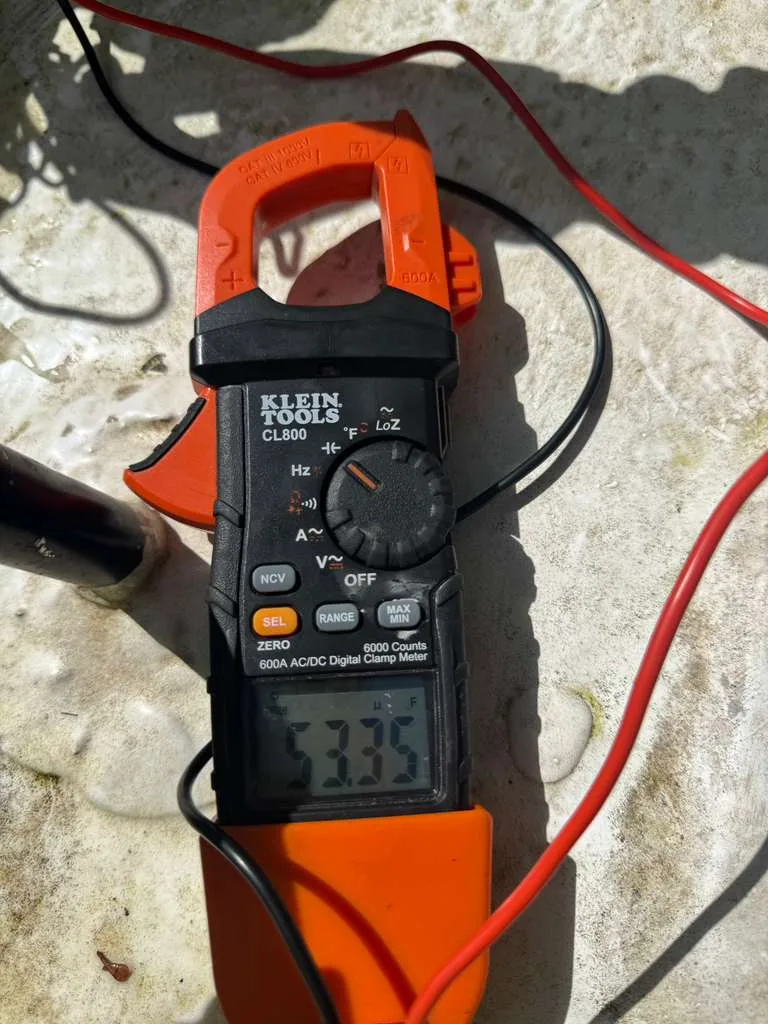
The shore power connection is where most Florida RV electrical problems start - either from a pedestal that has been wired incorrectly, a cord that is degraded, or a connection that is loose enough to arc under load. All three are conditions a simple outlet tester and a visual inspection catch before you plug anything in. Thirty seconds before the connection is made is the right time to do the check.
Why is the shore power connection the highest-risk moment?
Because it is the moment you connect your coach's entire electrical system to a campground pedestal that may be decades old, may have been wired incorrectly at any point in its service life, and may have connections that are loose or corroded in ways that are not visible from outside.
Florida campgrounds with aging infrastructure are common, and a pedestal that is technically passing a visual inspection can still have a reversed polarity, a missing ground, or a neutral that is not bonded at the panel - any of which creates a situation that is unsafe before you turn anything on.
The surge and load from connecting a thirty or fifty amp coach to shore power runs through the inlet connector on both sides of the connection. A connector that has been arcing at the pedestal - which happens when the plug is not fully seated or when the receptacle contacts are worn - heats up under load. That heat progresses to melting and then to fire if the connection is not caught early.
A shore power outlet tester that checks polarity and ground presence costs very little and takes five seconds to use before you plug in. If the tester shows a fault, do not plug in and report the fault to the campground. That is the entire safe procedure.
What does a surge protector protect against and what does it not?
A properly rated surge protector protects against voltage spikes from lightning strikes to the campground grid, from utility switching events, and from the voltage fluctuations that happen when a large load elsewhere in the campground switches on or off. Those spikes can reach several thousand volts in a fraction of a second and are enough to destroy sensitive electronics in the coach.
What a basic surge protector does not protect against is sustained over or under voltage. A campground with a voltage problem that runs all night at a hundred volts rather than a hundred and twenty is not producing spikes - it is producing sustained low voltage that overworks every motor in the coach that is trying to draw its rated current at reduced voltage. That is a separate protection category.
An advanced electrical management system that monitors voltage continuously and disconnects when voltage falls outside a safe range protects against both conditions. For full-time or frequent Florida campground use, the more complete protection is appropriate because pedestal voltage problems are more common than owners realize, particularly at older campgrounds during high-use periods in winter season.
A surge protector is not a substitute for checking the outlet. A protector that is connected to a miswired outlet will protect against spikes on a circuit that is already wrong, which is a false sense of security. Check the outlet first, then protect against what a correct outlet can still do.
How does Florida's humidity create electrical problems that dry climates do not?
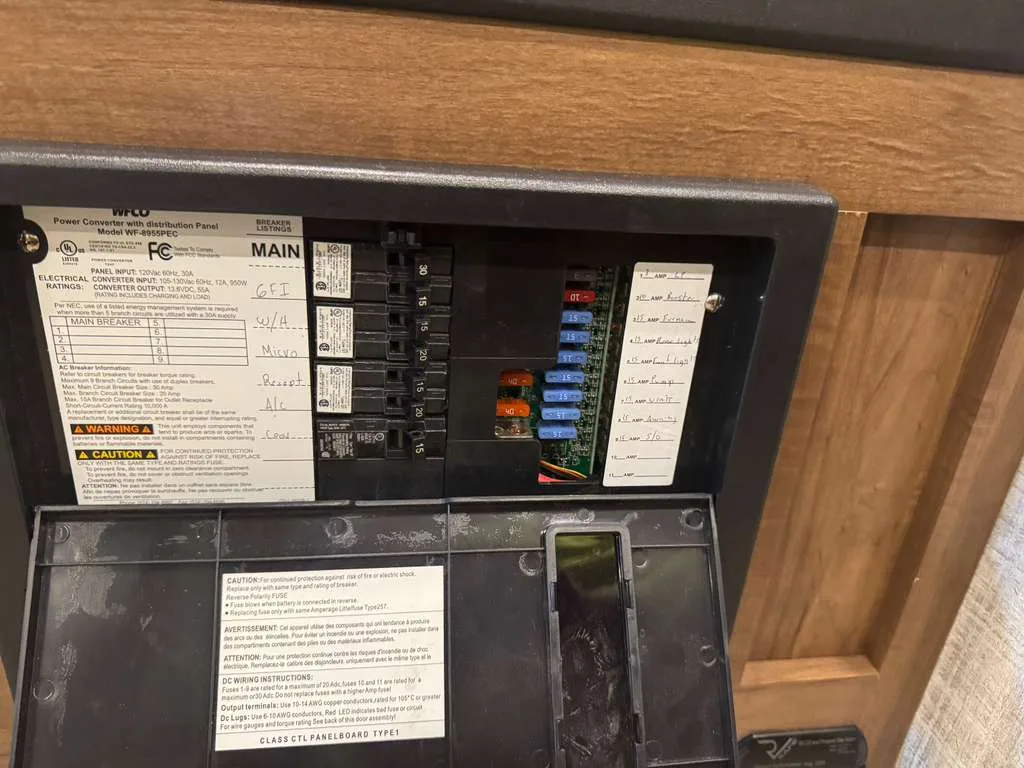
Humidity conducts electricity. Not well, but well enough to create leakage currents between conductors that should not have any connection, and those leakage currents trip GFCI outlets and circuit breakers at loads where there is no obvious fault.
The most common manifestation is a GFCI outlet or breaker that trips repeatedly for no apparent reason. In a dry climate, a GFCI trip means there is a ground fault somewhere in the circuit. In Florida's humidity, a GFCI trip can mean the leakage current caused by moisture between conductors has exceeded the five-milliamp threshold that trips the GFCI, even though no actual ground fault exists.
Persistent humidity also accelerates corrosion on the bus bars and terminal blocks inside the converter and the distribution panel. Corroded connections have higher resistance, which means they produce heat under load. A connection that is fine at low current and warm at full load has corrosion that needs to be cleaned before it progresses to arcing.
Coastal coaches have salt air to contend with in addition to humidity, which accelerates corrosion on the exterior electrical components - the inlet, the transfer switch, and any exterior-mounted outlet - more than on interior components. Annual inspection of exterior electrical connections is more important on a coastal coach than on one from an inland location.
What does a GFCI outlet in your panel protect and where should they be?
A GFCI outlet protects the circuit it is on from ground fault current - current that is flowing from a live conductor through an unintended path, such as through a person or through water, to ground. It trips when it detects more than five milliamps of difference between the current going out on the hot wire and the current returning on the neutral.
In an RV, GFCI protection is required at all bathroom outlets, kitchen outlets within six feet of the sink, and exterior outlets. A coach that does not have GFCI protection in those locations is out of current electrical code, which matters both for safety and for insurance purposes.
A GFCI outlet protects all downstream outlets on the same circuit - if the GFCI outlet is the first outlet on the circuit, everything after it is also protected. Many coaches wire the bathroom and kitchen outlets to a single GFCI outlet that is in one location, so tripping it kills all the downstream outlets. That can look like multiple outlet failures when it is a single GFCI trip.
Reset a tripped GFCI only after removing the load that caused it to trip. Resetting it with the load still connected and finding it trips immediately means the fault is in the load, not the outlet. Resetting it and finding it holds means the trip was a transient - possibly humidity-related - and the circuit is fine.
Why does the 30 amp versus 50 amp distinction matter at Florida campgrounds?
Because a thirty-amp coach plugged into a fifty-amp pedestal via an adapter, or the reverse, is a mismatch that has specific limits and specific risks that the adapter itself does not communicate.
A thirty-amp service provides one hundred and twenty volts on a single leg with a thirty-amp maximum current - that is thirty-six hundred watts maximum under ideal conditions. A fifty-amp service provides two hundred and forty volts on two legs at fifty amps each, which is a twelve-thousand-watt maximum. Running a fifty-amp coach on a thirty-amp service limits you to one leg's worth of circuits and requires managing loads to stay under the limit.
The adapter that converts a fifty-amp plug to a thirty-amp receptacle is a legitimate and safe device for temporary use, but it has to be rated for outdoor use, has to be fully seated, and has to be monitored for heat during use. An adapter that is warm to the touch during normal use has connections that are not making good contact. A hot adapter has a failing connection that needs to be replaced.
Florida's summer peak demand at campgrounds - when every coach is running its AC - can stress an older pedestal's wiring even at its rated amperage. A pedestal that is warm to the touch around the outlet, or that shows discoloration at the inlet, has been running at near-capacity and deserves more careful inspection of your adapter connection.
What does the shore power pedestal condition tell you?
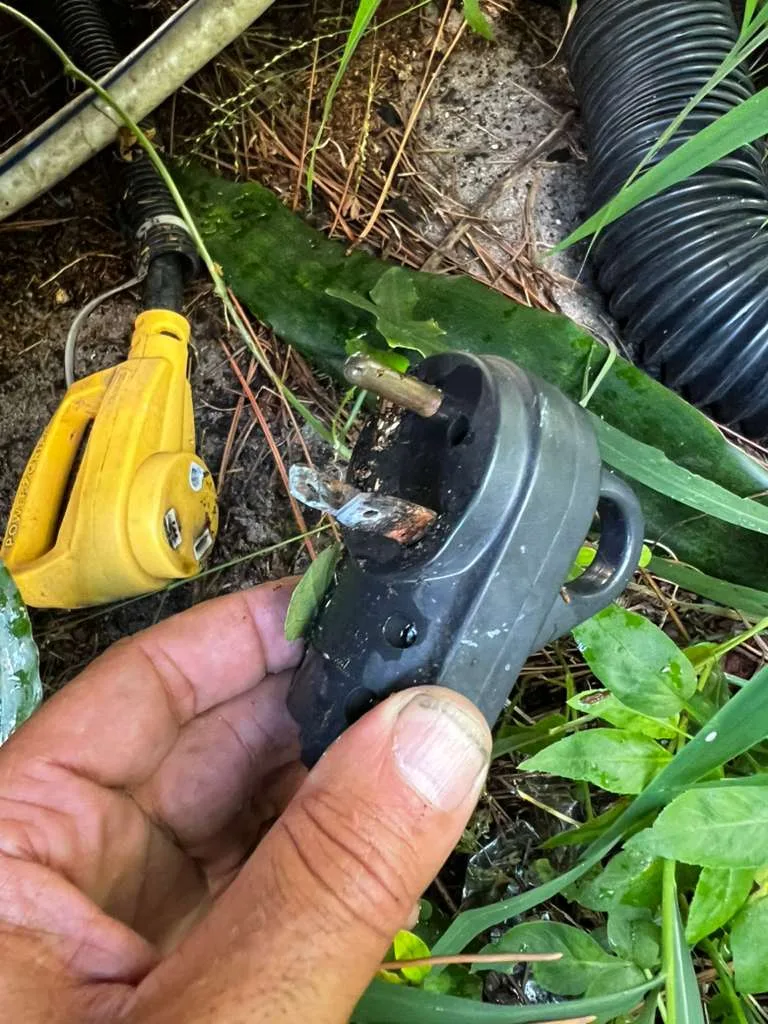
The exterior of the pedestal tells you the recent use history of the outlet. Discoloration around the receptacle face, melted plastic at the inlet edge, or a receptacle that does not hold a plug firmly are all signs of previous arcing events. Arcing at a connection produces heat, and that heat is the warning sign that the connection is degrading.
Check the inside of your own coach inlet after each extended hookup as well. A burnt or discolored inlet face on your coach, or a plug blade that shows pitting or discoloration, means arcing has occurred at your connection. That specific inlet needs service before the next hookup - the pitted or discolored blade creates a worse connection than a new one, which makes the next arcing event more likely.
A wet pedestal is a hazard. Campground pedestals are weatherproof, not waterproof, and a pedestal that has pooled water around the outlet base after a Florida thunderstorm may have water inside the housing. Do not plug in to a pedestal that has visible standing water around it. Give it thirty minutes after rain has stopped and the standing water has drained before connecting.
Our electrical service page covers what a shore power inlet inspection involves and what the repair looks like when arcing damage is found. A burned inlet is a repair, not something to work around with a different adapter.
How to check for a miswired outlet before plugging in
An outlet tester is a plug with three indicator lights that tells you in five seconds whether the hot and neutral are correctly wired, whether the ground is present, and whether they are reversed. The most common fault at aging campground pedestals is an open ground, where the ground wire is not connected or has a broken connection.
An open ground at the pedestal means your surge protector's ground protection does not have a path to earth. It also means that in the event of a fault in the coach, the fault current has no direct path to ground and will find another one - which may be through a person touching a grounded surface.
Reversed polarity - where the hot and neutral wires are swapped - creates a situation where equipment that is switched off is still hot on the terminal that should be neutral. That is a shock hazard on any equipment with a neutral-referenced switch, which includes some older appliances.
If the outlet tester shows a fault, unplug it and report the fault to the campground management before anyone else plugs in. A pedestal with an electrical fault is a hazard for every coach that uses it, and the campground has an obligation to address it.
When should you walk away from a hookup site?
When the outlet tester shows a fault and the campground either cannot fix it promptly or asks you to try it anyway. When the pedestal shows visible heat damage, melted plastic or a loose receptacle face that does not secure your plug. When you can smell a burning or electrical smell from the pedestal housing.
If you are already connected and you notice any of the following, disconnect and move sites: the shore power cord is warm or hot to the touch at any point, the coach inlet or the adapter is warm to the touch, or your surge protector is showing an error condition. These are conditions that are getting worse, not stabilizing.
A tingling sensation when you touch a grounded metal surface on the exterior of the coach while on shore power is a definitive signal to disconnect immediately. That sensation is current flowing through you to a ground path, which means there is a fault either in the coach or the pedestal connection that is producing current on a surface that should be at zero volts.
A functioning surge protector that has disconnected and is showing an error is telling you the same thing the outlet tester would tell you - that the source power has a problem that it is protecting you from. Read the error code on the display before you reset it. If the error is open ground, low voltage, or reversed polarity, those conditions have not self-corrected.
Questions RV owners ask about electrical safety in Florida
What surge protector do you recommend for Florida camping?
Any unit rated for your service amperage that includes voltage monitoring in addition to surge protection - not just a basic MOV-based surge protector. Units from Progressive Industries and Southwire are commonly used and have reliable protection at both amperage ratings. The voltage monitoring feature is what catches the slow-burn campground power problems that a spike protector misses entirely.
My GFCI keeps tripping even with nothing plugged in - what does that mean?
It likely means moisture is present in the outlet housing or in the wiring between the GFCI and the next outlet downstream. A GFCI that trips on its own circuit with nothing plugged in has leakage current that may be caused by moisture in Florida's humidity. Dry out the outlet housing and any exposed wiring, and if it continues tripping, there is a wiring fault that needs a technician.
Is it safe to run a generator in a Florida campground?
Follow the campground's generator hours and placement rules first. For safety, keep the generator exhaust pointed away from the coach, positioned downwind, and never run it inside a storage bay or under an awning where exhaust can accumulate. Carbon monoxide from a generator is the most serious risk and it is invisible and odorless.
My coach has 50-amp service but the campground only has 30-amp pedestals - how should I manage this?
Use a correctly rated 50-to-30-amp adapter, plug in, and manage your loads to stay under thirty amps total. That means you cannot run two rooftop AC units simultaneously, and you may need to manage the water heater and converter timing to stay under the limit. An energy monitor that shows your current draw in real time makes this straightforward.
What causes the tingle I sometimes feel touching the exterior of my RV?
This is stray voltage, which is caused either by a fault in your coach's electrical system or a fault at the pedestal. It means there is a voltage difference between the coach skin and true earth ground. It is a serious fault condition even when the tingle is mild. Disconnect from shore power and have the electrical system inspected before the next hookup.
How often should the RV electrical system be professionally inspected in Florida?
Annually is appropriate for a coach that is used regularly year-round, which most Florida coaches are. The inspection should cover the shore power inlet, all GFCI outlets, the distribution panel interior for corrosion, and all exterior electrical connections. A coach that is stored for extended periods should be inspected before the first hookup of each season.
Sources
- US Fire Administration - fire prevention - Electrical fire causes and prevention, including the arc faults and overloaded connections that are the primary electrical fire risk in recreational vehicles.
- US EPA - mobile source safety - Carbon monoxide exposure from generators and vehicles, relevant to generator safety in campground settings.
- Dometic - product support - Service and specification documentation for Dometic electrical components and the systems connected to shore power in RV applications.
- US Department of Energy - Energy Saver - Load management information useful for understanding the power demand of AC units on shore power circuits at Florida campgrounds.