Mobile RV Roof Repair and Resealing Across Florida
Water enters at a seam, a fastener or a fitting and travels before it shows. Finding the entry point is the job; sealing it is the easy part.
An RV roof leak almost never enters directly above the stain inside. Water gets in at a seam, a screw or a fitting, then runs along a rafter or inside the wall until it finds a way down. That is why resealing the visible area rarely stops it, and why tracing the entry point is the part of this job that actually matters.
Why is the leak never where the stain is?
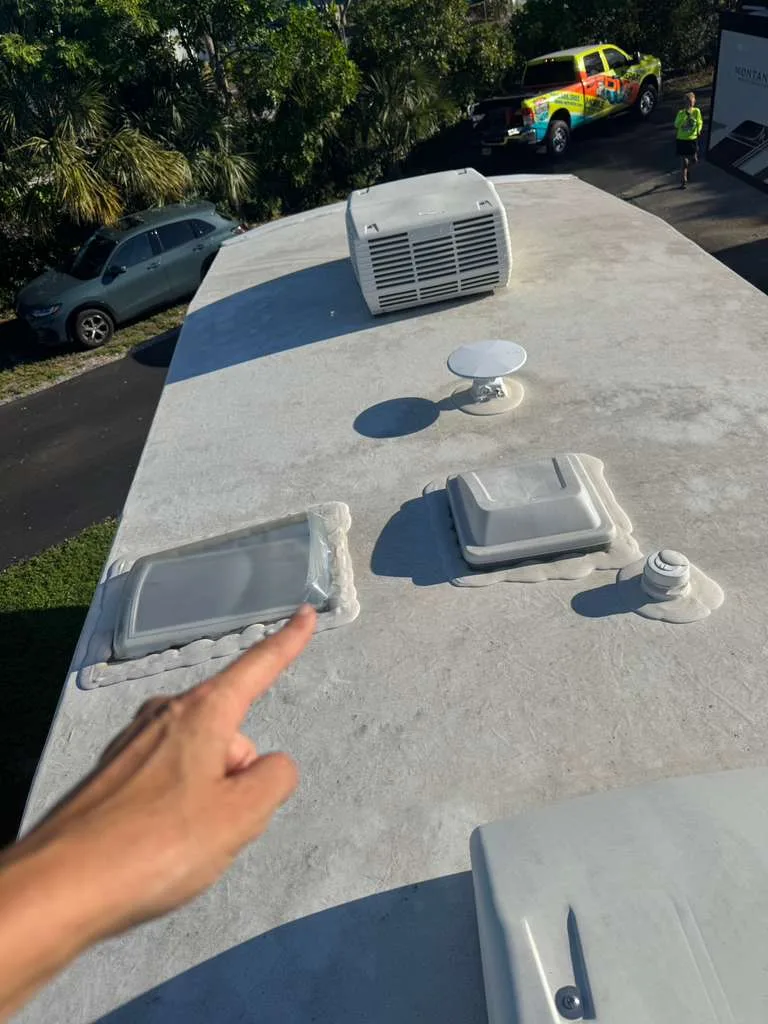
Because a roof is a layered structure and water travels along the layers before it finds a way through them.
Above the ceiling panel there is a membrane, a layer of decking, a set of rafters and usually a layer of insulation. Water that gets past the membrane lands on the decking and follows the slope, or runs along the top of a rafter, sometimes several feet, before it reaches a screw hole or a joint it can drip through.
That is why the stain on a ceiling panel is a poor guide to where to seal. Resealing directly above it addresses a spot the water was merely passing under.
It also explains why leaks appear to move, or to stop and come back. The path changes with how the coach is parked. Two coaches with the same entry point can show damage in completely different places.
Where do RV roofs actually leak?
At the penetrations and the edges, in that order, and hardly ever in the middle of an intact membrane.
Every fitting on the roof is a hole cut through the membrane and then sealed around: the air conditioner, vents, skylights, antennas, solar mounts and the refrigerator flue. Each one is a candidate, and the sealant around them is the consumable part rather than the fitting itself.
The edges are the second group. The front and rear caps meet the roof at a seam covered by a strip of sealant, and that seam flexes every mile the coach travels. The awning rail and the sidewall trim above it are the same story.
The membrane itself fails from age and abrasion rather than at random, and when it does it is usually visible as chalking or cracking well before it leaks.
How often should an RV roof be resealed?
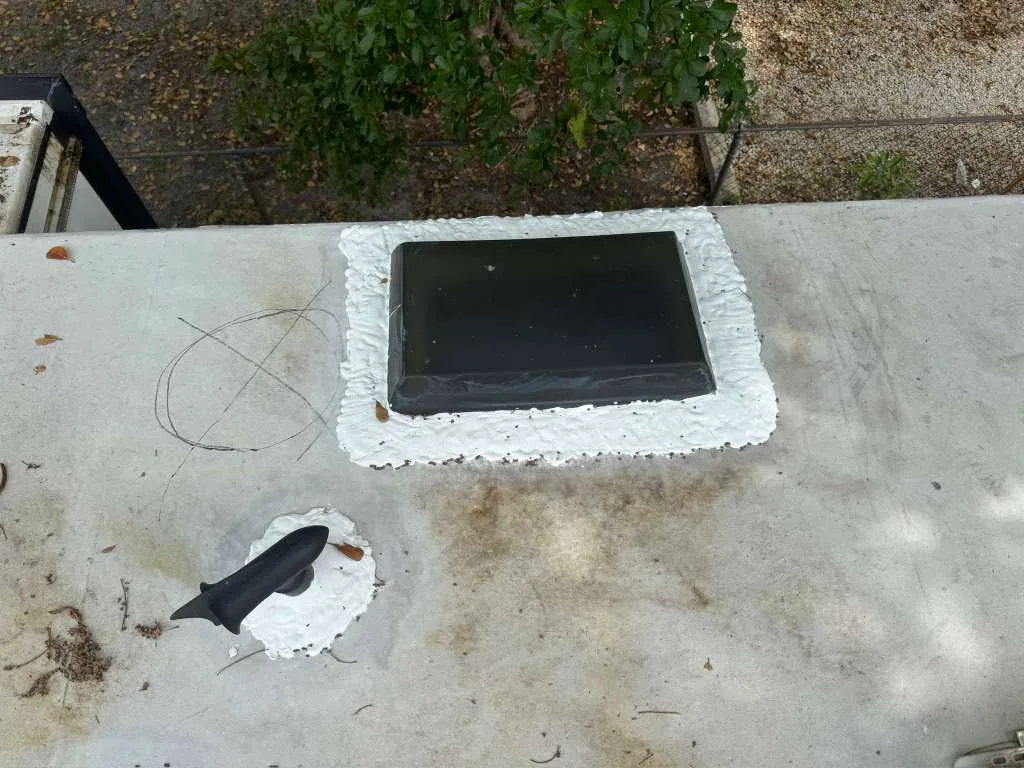
Inspected twice a year and resealed on condition, which in Florida means more often than the manufacturer's northern interval suggests.
Ultraviolet exposure is what ends sealant, and this state supplies more of it than almost anywhere the coach was designed for. Self-leveling lap sealant on the horizontal seams goes chalky, then crazes, then loses adhesion at the edges, and the sequence is visible long before water gets through.
The inspection is what matters more than the calendar. Anything cracked, lifted at an edge, or pulling away from a fitting gets cleaned back and redone; anything sound is left alone, because adding sealant over failing sealant traps water rather than excluding it.
The manufacturer's own instructions specify which product goes on which surface, and self-leveling sealant belongs on horizontal seams while non-leveling belongs on vertical ones. Mixing the two is a common cause of a reseal failing inside a single season.
What does Florida weather do to a roof specifically?
It combines the two things that end a membrane fastest: continuous ultraviolet and repeated heavy rain.
The ultraviolet degrades the sealant and chalks the membrane surface. The rain then arrives in volume rather than as drizzle, so any gap that has opened is tested immediately and at pressure, often with wind driving water sideways under an edge that would shed a vertical fall.
Afternoon storms through the summer mean this cycle repeats most days for months. A coach stored uncovered here ages its roof considerably faster than the same coach would in a drier state.
Named storms add debris and branch impact on top of that, which is why we check the whole roof after one rather than only the area an owner noticed. That is also why we recommend inspecting after a storm rather than waiting for the next scheduled look, since impact damage does not announce itself.
Can a soft spot in the roof be repaired, or is it structural?
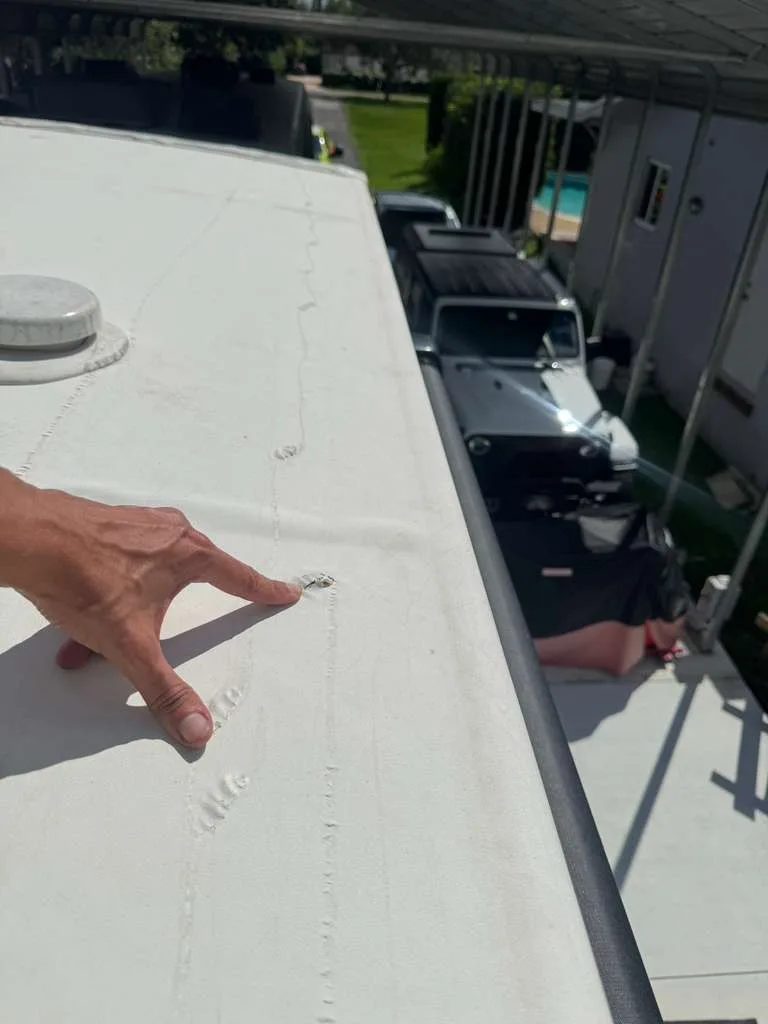
It depends entirely on whether the softness is the decking or only the insulation, and that has to be established before anything is quoted.
A roof that flexes underfoot has usually had water sitting on the decking long enough to delaminate it. At that point sealing the membrane above changes nothing, because the structure below has already failed and will keep failing.
The honest test is a moisture survey rather than a walk. Meter readings across the roof and the upper walls show how far the wet area actually extends, which is nearly always further than the soft patch suggests.
Where the decking is sound, a membrane patch or a section replacement is a genuine repair with a long life. Where it is not, our water damage service is the honest answer. Establishing which of the two you have is the whole point of looking before quoting.
What is involved in replacing a vent or skylight?
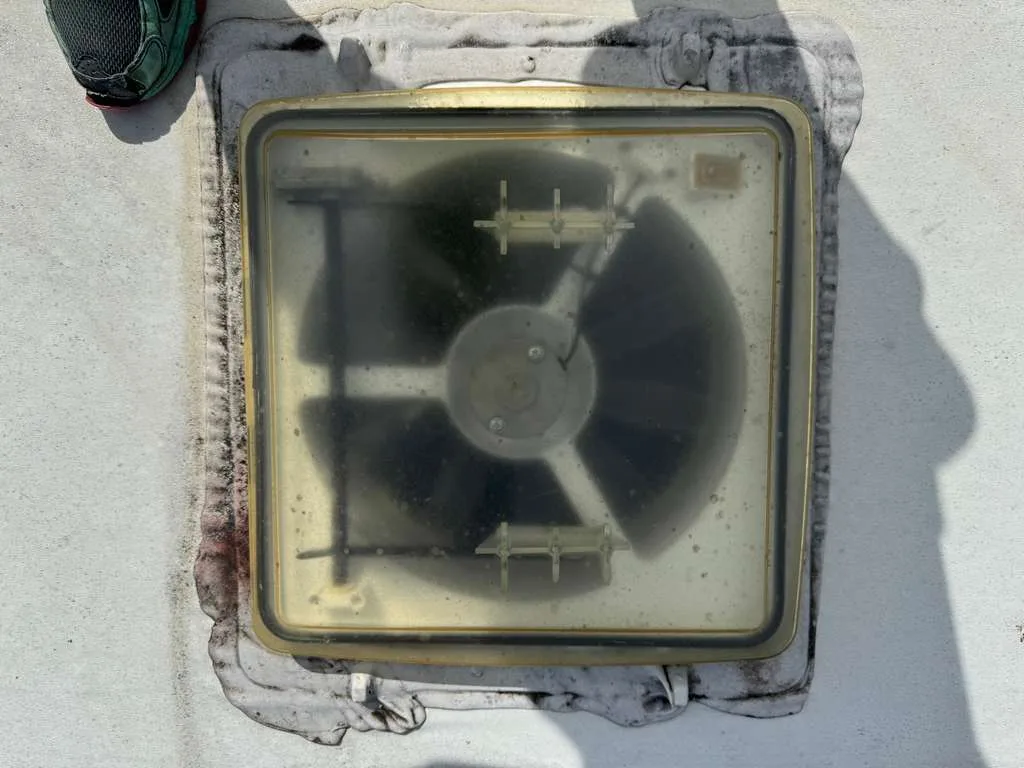
Removing the old sealant completely, lifting the unit, cleaning the opening back to a sound surface, and bedding the new one properly.
The step owners most often skip is the first one. Old sealant has to come off entirely rather than be built over, because a new bead laid on a failed one adheres to the failure rather than to the roof.
The opening itself is then inspected. This is the point at which soft decking around a long-standing leak shows up, and it is far better found with the unit out than discovered later.
The new fitting is bedded in butyl, fastened evenly rather than over-tightened, and finished with self-leveling sealant over the flange. Skylights follow the same sequence, and a cracked skylight is worth replacing rather than patching. Cracked skylights are also a common storm casualty and worth checking after one.
Should the roof be coated, or just resealed?
They solve different problems, and coating a roof to fix a leak is the wrong tool applied confidently.
Resealing addresses the seams and penetrations, which is where water actually gets in. A full coating addresses a membrane that has aged across its whole area - chalking, crazing, loss of surface - and it buys years on a roof that is otherwise sound.
A coating applied over an active leak seals water in and hides the evidence. It also has to go onto a properly cleaned and prepared surface or it lifts, and preparation is most of the labor in that job.
The honest sequence is to fix the leaks first, confirm the decking is dry, and only then decide whether the membrane itself justifies a coating. Done in that order a coating is a genuinely good investment; done in the wrong order it is an expensive way to hide a problem.
How do you find a leak that only appears sometimes?
By reproducing the conditions rather than waiting for them, and by measuring rather than looking.
A leak that only shows in driving rain is usually entering at a vertical surface or under an edge that sheds a straight fall perfectly well. Water directed at the coach from the side finds it; a hose pointed downward at the roof does not, which is why the obvious test so often comes back clear.
Moisture meters change this from guesswork into a map. Readings taken across the ceiling, the upper walls and around each fitting show where the wet area extends to, and the entry point sits at the edge of it.
Our water damage guide covers the signs that appear before a stain does, most of which are smell and feel rather than anything visible. A meter reading is also evidence, which matters if the damage ends up going to an insurer.
What Does Mobile RV Roof Repair Cost?
These are typical ranges for mobile service across Florida. A brief description of what's included is in the Notes column.
| Service | Typical Range | Notes |
|---|---|---|
| Service call (trip + 1st hour diagnosis/labor) | $299 - $399 | All-in for getting us to your site + first hour on any job. Exact rate confirmed at booking; varies by location. |
| Spot reseal (single seam or vent) | $95 - $220 | Self-leveling or Dicor; sealed same day |
| Full roof reseal (perimeter + penetrations) | $480 - $1,400 | All seams, vents, AC, and edges |
| EPDM / TPO section repair | $350 - $900 | Delamination patch; size-dependent |
| Full EPDM membrane replacement | $2,800 - $7,500 | Strip, inspect, re-deck if needed, new membrane |
| Roof decking (water-damage section) | $600 - $2,200 | Subfascia and decking only; separate from membrane |
| Vent lid / fan replacement | $120 - $380 | Fantastic Fan, MaxxAir, and OEM vents |
| AC gasket and curb seal | $95 - $195 | Most common water-entry point below rooftop units |
Service call (trip charge + first hour) is $299-$399 depending on location - confirmed when you book. Repair line items below are national averages for mobile service (2025 data) and represent labor + parts after the first hour. Call (888) 702-6880 for an exact quote.
Roof questions RV owners ask us
Can you reseal my roof at a campground?
Yes, and most of this work is done exactly there. What it needs is a dry roof and a dry forecast for long enough to cure, which in a Florida summer means starting early rather than working around an afternoon storm.
How do I know what kind of roof I have?
The two common membranes are EPDM, which is rubbery and chalks white as it ages, and TPO, which is smoother and stays whiter. Fiberglass roofs are hard and glossy. It matters because the sealants and cleaners are not interchangeable and the wrong one shortens the life of the repair.
Is a leak covered by insurance?
It depends on whether the cause was sudden and accidental or gradual. Storm or impact damage is usually covered; a seam that has been failing for two seasons usually is not. Dated photographs of maintenance are what separates those two arguments after the fact.
How long does resealing take?
A straightforward reseal of the seams and fittings on a typical coach is a single visit. It grows when old sealant has to be cut back extensively, or when removing a fitting reveals decking that needs attention underneath.
Can I walk on my RV roof?
Some are rated for it and some are not, and the owner's manual is the authority rather than the look of it. Even on a walkable roof, weight belongs over the rafters rather than between them, and a roof that already flexes should not be walked on at all.
What is the first sign of a roof problem, before a stain?
Usually smell. A musty note inside a closed coach is water in the insulation, and it appears well before anything discolors. Soft spots underfoot, wrinkling in a ceiling panel and a wall that reads damp on a meter all come before a visible stain does.
Sources
- Dicor - sealant installation instructions - Manufacturer specification for which sealant goes on which surface, and how old sealant must be removed.
- EPA - moisture and mold - Why trapped moisture in a structure matters beyond the cosmetic damage.
- National Weather Service - Tampa Bay - Regional rainfall and storm patterns behind the reseal interval used here.
- Lippert Components - master manuals - Documentation for the roof structures, vents and fittings on most coaches.