RV Leveling and Jack Repair Across Florida
Jacks that will not move, systems that will not level, and landing gear that leaves a trailer unable to hitch. All of it diagnosed where the coach stands.
A jack that will not retract is far more often an electrical fault than a hydraulic one. These motors and pumps draw enormous current, so a battery that still runs the interior will stall them. The order that finds it is battery under load, then the fuse, then the controller, then the pump or motor itself. Every system has a manual override, and finding yours before you need it matters.
Why will the jacks not retract?
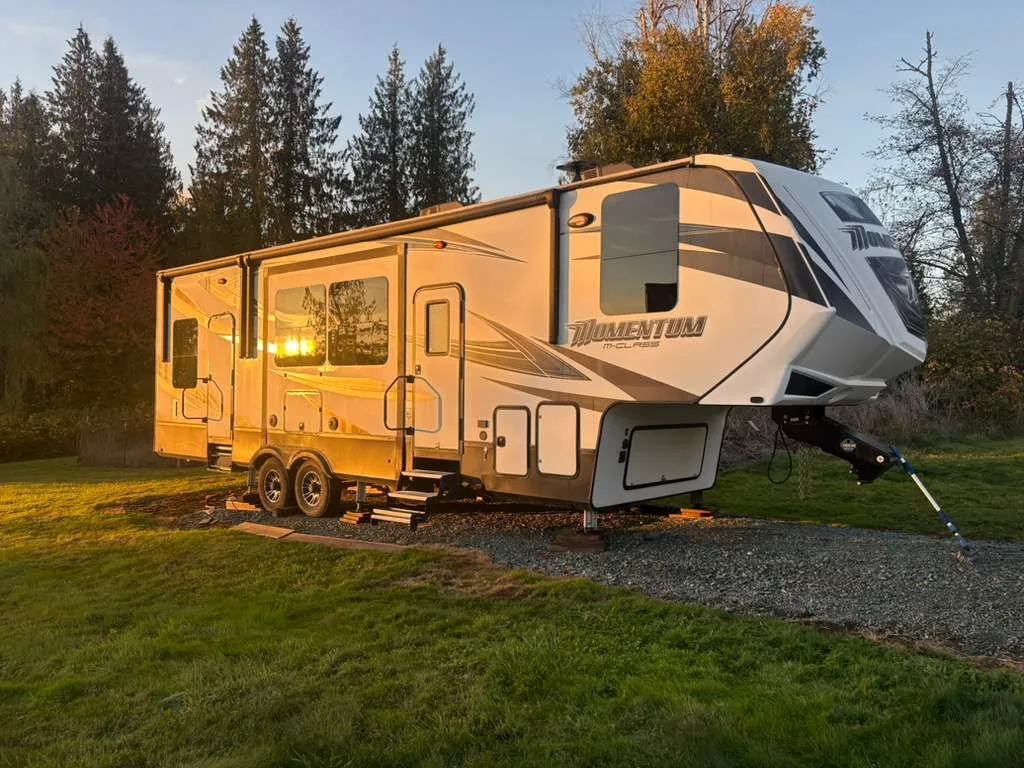
Because the pump or the motor is not getting the current it needs, and that is true far more often than a mechanical failure is.
A hydraulic pump lifting the corner of a loaded coach draws an enormous amount, and so does a screw jack motor. A battery bank that comfortably runs lights, a fridge and a fan can collapse under that load while giving no other sign that anything is wrong.
So the reading that matters is battery voltage taken while the switch is held down. A bank that looks acceptable at rest and drops away sharply under load has answered the question.
The identical symptom comes from a corroded ground or a loose battery terminal, because the voltage is lost in the connection rather than in the battery. Cleaning those is worth doing before any part is condemned.
What does an auto-level error code actually mean?
That the controller could not complete its sequence, which is usually a sensor or a supply problem rather than a failed jack.
An automatic system measures attitude, extends jacks in a defined order, and checks its own progress as it goes. If a jack does not reach where the controller expected, or the coach does not respond as predicted, it stops and reports rather than continuing blindly.
The three common reasons are low voltage part way through the sequence, a jack meeting soft ground and sinking rather than lifting, and a level sensor that has drifted out of calibration.
Soft ground deserves particular mention here, because Florida sites are frequently sand or damp grass. Pads under the feet fix a surprising share of auto-level faults, and they cost almost nothing compared with a service call.
How do hydraulic and electric systems differ in practice?
Hydraulic systems fail at fluid and seals; electric systems fail at gears and motors. The symptoms overlap and the repairs do not.
A hydraulic system has one pump feeding rams at each jack, often shared with the slide-outs. Low fluid is the most common cause of slow or partial movement, and a weeping ram loses pressure under load so the coach settles overnight.
An electric system drives a screw inside each leg through a gearbox. Its failures are stripped teeth, a sheared pin, a seized screw or a dead motor, and it usually announces itself by sound: a hum with no movement, or a motor suddenly running free.
Knowing which you have decides the first check. Fluid level on one; voltage and a listen on the other. Owners frequently do not know which they have, and the answer is usually visible in thirty seconds under the coach.
Why do jacks drift down overnight?
On a hydraulic system that is a seal or a valve passing fluid, and it is a genuine fault rather than a quirk.
A hydraulic jack holds position because fluid cannot escape from the ram. When a seal or a holding valve begins to pass, the weight of the coach pushes fluid slowly back and the corner settles. It usually shows as one corner rather than all of them.
It matters for more than convenience. A coach that has settled unevenly overnight is twisting its frame, and on a coach with slide-outs a change in attitude is what causes a room to bind when it is retracted the next morning.
Electric jacks do not drift in the same way, because a screw holds its position mechanically. An electric jack that appears to have moved has usually sunk into the ground rather than retracted.
Is it safe to work or sleep under a coach on its jacks?
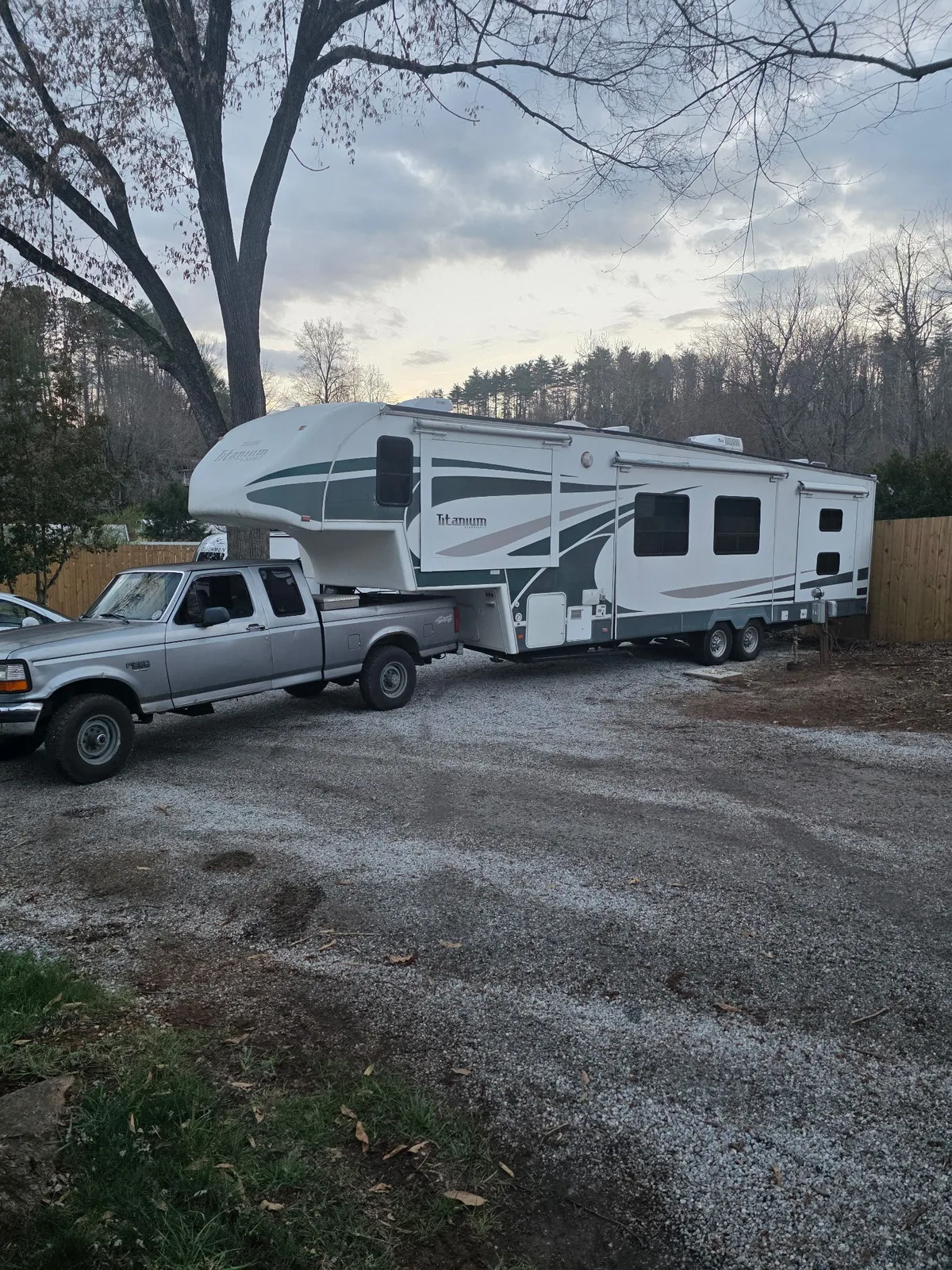
No, and this is the part of the job that is not a matter of opinion.
Leveling jacks are designed to level a coach, not to hold it up while somebody is beneath it. A hydraulic jack depends on fluid and seals, both of which can fail, and an electric one depends on a gearbox that can strip. Neither is a mechanical lock.
Anything that requires being under the coach requires rated stands taking the weight through the frame, with the jacks then relieved rather than trusted.
This applies to owners changing a tire as much as it applies to us. It is also why a jack that will not retract gets diagnosed rather than crawled under. Stands are inexpensive, they live in a bay, and they are the difference between a routine job and a serious accident. There is no version of this worth improvising.
What is the manual override, and where is it?
A way to bring the system in without power, and every coach has one because a system that could strand you would be unusable.
On a hydraulic system it is normally a release valve at the pump that lets fluid return so the jacks retract under the coach's own weight. On an electric system it is a motor disengagement and a hex or socket that turns with a drill or a hand crank.
The procedure differs by manufacturer and it is documented. Finding yours once, in daylight, with nothing wrong, is genuinely worth the ten minutes, because the moment you need it is never convenient.
What the override is not is a repair. The fault that stopped the system is still there, and forcing a jammed mechanism with a drill is how a bent leg happens. Our stuck mechanism guide makes the same point about slides.
What does Florida ground do to leveling systems?
It swallows jack feet and it corrodes everything underneath, and the two problems compound each other.
Sand, damp grass and shell sites all give way under a jack foot. A jack that sinks does not level the coach, and the controller reads that as a jack that failed to extend, which produces an error rather than a level coach.
Pads spread the load and solve most of it. They also keep the foot out of standing water, which is the second problem: salt air and constant damp corrode the rams, the screws and the electrical connections at each leg.
That corrosion shows up first as the low-voltage symptom at the top of this page, because a corroded connector at a motor drops voltage exactly like a tired battery does. A set of pads and an occasional rinse of the legs deals with both problems at once.
What should you check before calling us?
Three things, and any one of them can turn a service call into nothing at all.
Measure battery voltage while the switch is held, not at rest, because that is what the motor actually receives. Then find the fuse or breaker for the leveling circuit, which is usually a large one near the battery rather than in the interior panel.
Then look at what each foot is standing on and whether anything is obstructing the jack's travel. A foot that has sunk into wet ground, or a jack fouled on a kerb or a block, stops the system as effectively as any fault.
If those are clear, stop and call rather than repeating the cycle. Our electrical service covers the supply side and the mechanism is ours from there. Repeating the cycle on a system that has already stalled is what turns an electrical fault into a mechanical one.
What Does Mobile RV Leveling System Repair Cost?
These are typical ranges for mobile service across Florida. A brief description of what's included is in the Notes column.
| Service | Typical Range | Notes |
|---|---|---|
| Service call (trip + 1st hour diagnosis/labor) | $299 - $399 | All-in for getting us to your site + first hour on any job. Exact rate confirmed at booking; varies by location. |
| Manual stabilizer jack replacement | $95 - $220 | A-frame or scissor jack; per corner |
| Electric jack motor / actuator | $220 - $580 | Single-point; Lippert, Atwood, BAL |
| Hydraulic pump service | $280 - $750 | HWH or Lippert; fluid flush and seal |
| Auto-leveling control board | $350 - $950 | LCI Level-Up, HWH AP4; wiring check |
| Level sensor / tilt switch | $110 - $310 | Calibrated after replacement |
| Slide-leveling valve (hydraulic) | $200 - $550 | Combined slide + leveling systems |
Service call (trip charge + first hour) is $299-$399 depending on location - confirmed when you book. Repair line items below are national averages for mobile service (2025 data) and represent labor + parts after the first hour. Call (888) 702-6880 for an exact quote.
Leveling questions RV owners ask us
Can I drive with a jack that will not fully retract?
No. A partly extended jack is the lowest thing on the coach and the first driveway lip or steep entrance will catch it, which turns a jack repair into a frame repair. Bring it up manually and confirm the indicator agrees before moving.
Why does my system say it is level when the coach clearly is not?
The sensor has drifted, or it was calibrated while the coach was not actually level. Recalibration is a defined procedure done on known-level ground, and it is worth doing after any suspension or frame work rather than assuming the sensor is faulty.
How often does hydraulic fluid need changing?
Less often than owners expect, but the level wants checking at least annually and always if the system has become slow. Topping up with the wrong fluid is a real risk - the manufacturer specifies a type, and mixing them attacks the seals.
Do jack pads actually make a difference?
A large one, particularly here. They stop the foot sinking on sand and wet grass, which prevents most auto-level errors, and they keep the foot out of standing water so the leg corrodes more slowly. They are among the cheapest things you can buy for a coach.
Should I level with the slides in or out?
Level the coach first, then extend the slides. Extending a room changes the weight distribution, and a coach leveled around an extended slide will be out again as soon as it is retracted. It also puts the room into its opening square, which is what the seals need.
Can you repair landing gear on a fifth wheel?
Yes, and it is the same diagnostic order: battery under load, fuse, motor, then the gearbox and screws. Landing gear that will not move is more urgent than a leveling jack, because a trailer that cannot raise its front cannot be hitched or unhitched at all.
Sources
- Lippert Components - leveling and stabilization - Manufacturer documentation for the electric and hydraulic leveling systems fitted to most coaches.
- Lippert Power Gear - hydraulic leveling - Hydraulic system documentation including the manual release procedure.
- Lippert - leveling owners manual - Calibration and error reporting behavior for automatic leveling controllers.
- InterNACHI - inspection standards - Inspection guidance covering support systems and safe practice around a supported vehicle.