Mobile RV Slide-Out Repair Across Florida
A slide that will not move is a coach that cannot travel. We diagnose Schwintek, hydraulic and cable systems where the RV is parked, before anything gets forced.
A slide-out that stops halfway is usually reporting power, not mechanism. These motors draw heavily, so a battery that still runs the lights will stall one. After that the order is the fuse, the controller, then the mechanism itself. Forcing a stuck slide is what turns an inexpensive repair into a bent rail, and it is the single most expensive mistake owners make here.
Why does a slide-out stop halfway?
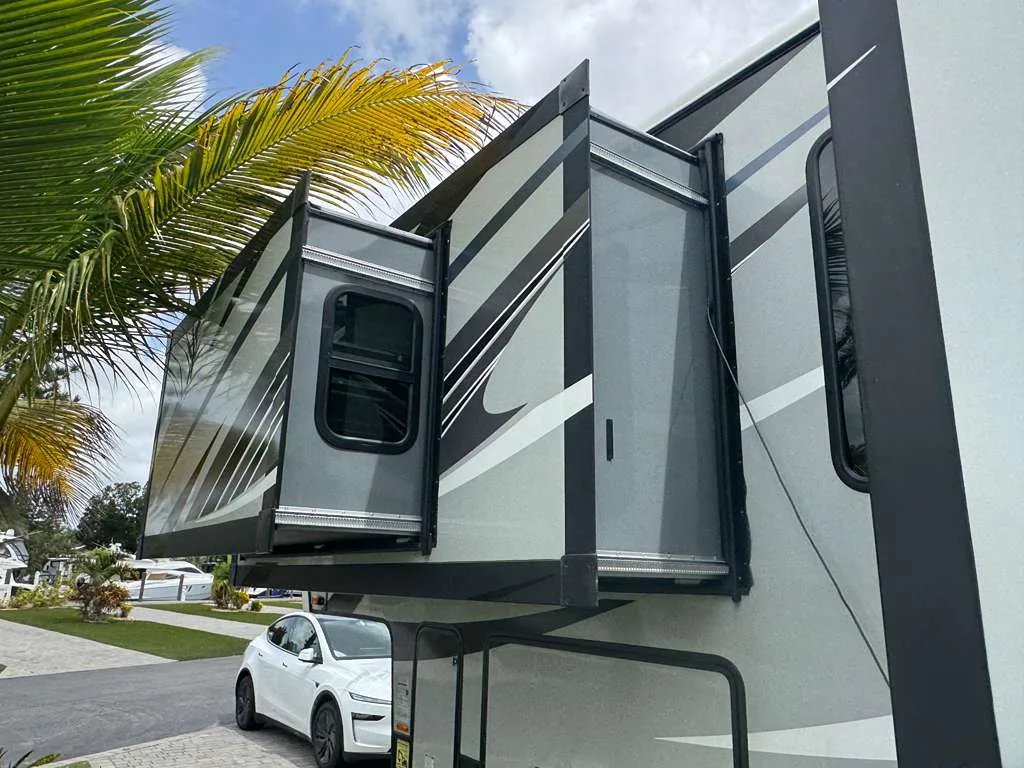
Because it ran out of the current it needed, and it needs a great deal more than owners expect.
A slide motor moves a substantial weight along a rail with a high gear reduction, and the current it draws while doing that is enormous compared with anything else in the coach. A battery that comfortably runs lights, a water pump and a fan will collapse under it, and the giveaway is that everything else in the coach appears to be working normally.
So the reading that matters is voltage taken while the switch is held, not at rest. A pack that reads acceptably with nothing running and drops sharply under load has already told you the answer.
The related cause is a corroded ground connection, which produces an identical symptom because the voltage is lost in the connection rather than in the battery. Cleaning grounds is worth doing before anything is condemned.
What is different about a Schwintek slide?
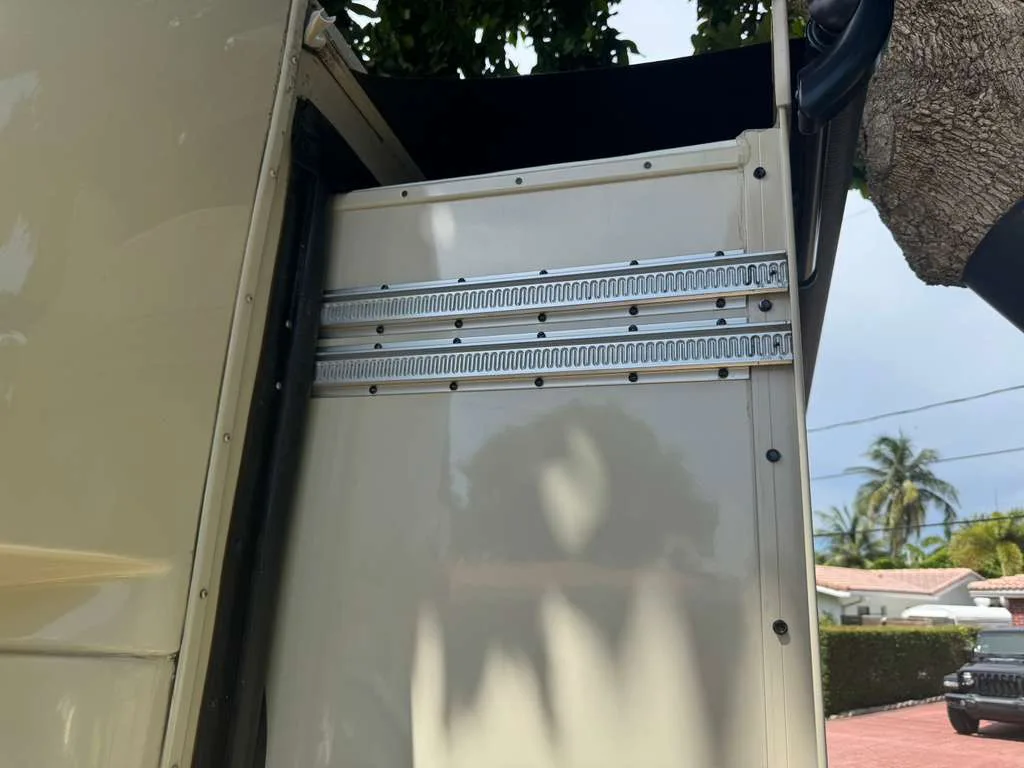
It drives the room from vertical toothed racks on each side rather than from a ram or a cable, and that changes every failure mode it has.
Two motors, one at each side, have to stay in step with one another. The controller counts and compares them, and when one side runs ahead the room goes into the wall at an angle, binds, and stops. That is the classic out-of-sync fault and it presents as a slide that moves an inch and stalls.
Retiming is the fix and it is a defined procedure, not a matter of nudging the switch. Done properly it resets both sides to a known position and the room tracks square again.
The wear part is the toothed rack and the gear pack that runs on it. Both are replaceable, and both last considerably longer on a coach whose seals and rails are kept clean.
How do hydraulic slides fail differently?
They fail at fluid, seals and the pump rather than at gears, and they give more warning before they stop.
A hydraulic slide is pushed and pulled by a ram fed from a central pump, often the same pump that runs the leveling jacks. Low fluid is the most common cause of a slide that moves slowly or partway, and the reservoir is easy to check once you know where it is.
Seals are the second. A ram that has started to weep loses pressure under load, so the room creeps back in rather than holding, and there is usually visible fluid to confirm it.
The third is the pump itself or its solenoid, which typically announces itself with noise rather than silence. A pump that runs but produces no movement is a different diagnosis from one that does not run at all, and the two separate quickly.
Why does a slide leak, and is that the seal's fault?
Usually not. The seals are the last line, and by the time they leak the room is normally sitting slightly wrong.
A slide room seals against its opening with a wiper on the outside and a bulb seal that compresses when the room closes. Both depend on the room arriving square and at the right depth. A room that is half an inch out at one corner leaves a gap no seal can close, and replacing the seal changes nothing.
So a leaking slide is inspected as an alignment problem first and a seal problem second. Adjusting the stops and the timing so the room seats evenly fixes a large share of them without new parts.
Where seals genuinely have failed they harden, split at the corners or take a permanent set, and in this climate ultraviolet is what does it.
What does Florida do to slide-out systems?
It attacks the seals from above and the mechanism from below, and the mechanism part is the one owners never see.
Ultraviolet hardens the rubber seals and the topper fabric on a schedule measured in seasons rather than years here. A topper that has gone brittle tears in the first storm, and then water sits directly on the roof of the room.
Underneath, salt air and humidity corrode the rails, the rack teeth and the electrical connections. A coach kept near the coast will show corrosion at the motor connectors long before anything mechanical wears out, and that corrosion presents as the low-voltage symptom described above.
Both problems respond to the same maintenance: keep the seals conditioned, keep the rails clean and dry, and operate the slide regularly rather than leaving it in one position for months.
Can a stuck slide be brought in manually?
Yes, every system has an override, and knowing where yours is before you need it is worth the ten minutes it takes to find.
On a hydraulic system there is a valve to release pressure so the room can be pushed. On a cable or rack system there is usually a motor disengagement and a point to turn with a drill or a hand crank. The procedure differs by manufacturer and it is documented.
What matters is that a manual retract is a way to travel safely, not a repair. The fault that stopped the slide is still there and the room should not be operated again until it is found.
Never force a jammed room with the override. If it will not move by hand either, something is binding, and driving it harder bends a rail. Our stuck slide guide covers the order in detail.
What does forcing a slide actually break?
The rail, the rack teeth and occasionally the wall the room sits in, in ascending order of expense.
A slide that is binding is already loaded against something. Holding the switch adds current and torque to a mechanism that cannot move, and the weakest component gives first. On a Schwintek that is normally the rack teeth or the gear pack; on a cable system it is the cable or its pulley.
The costly outcome is a bent rail, because that is no longer a parts swap. A room running on a distorted rail never seats squarely afterwards, which brings back the leak problem permanently.
This is why the honest advice on a stuck slide is to stop and diagnose rather than to try once more. Almost everything on this list is repairable until somebody forces it.
What should you check before calling us?
Three things, and between them they account for a real share of the calls that come in as a dead slide.
Check battery voltage while the switch is held rather than at rest, because that is the reading that reflects what the motor actually receives. Then find the fuse or breaker for the slide circuit, which on many coaches is a large one near the battery rather than in the interior panel.
Then look along the seals and the top of the room for anything obstructing it. A branch, a chair, an awning arm or a jammed topper roller stops a slide as effectively as any electrical fault, and it is the cheapest possible outcome.
If all three are clear, stop there. Our electrical service covers the supply side and the mechanism is our job from that point.
What Does Mobile RV Slide-Out Repair Cost?
These are typical ranges for mobile service across Florida. A brief description of what's included is in the Notes column.
| Service | Typical Range | Notes |
|---|---|---|
| Service call (trip + 1st hour diagnosis/labor) | $299 - $399 | All-in for getting us to your site + first hour on any job. Exact rate confirmed at booking; varies by location. |
| Slide motor replacement | $280 - $650 | Electric room slides; Lippert, Schwintek, HWH |
| Slide adjustment / realignment | $145 - $350 | Travel, seal gap, or room-level issues |
| Rack-and-pinion gear service | $180 - $480 | Cleaning, inspection, and lube |
| Schwintek rail and gear replacement | $350 - $950 | Tongue-and-groove rail systems |
| Wiper / bulb seal replacement | $165 - $390 | One full room; water-leak prevention |
| Topper fabric replacement | $320 - $850 | Slide topper awning; full replacement |
| HWH hydraulic pump service | $250 - $750 | Level-Plus and slideout hydraulic units |
Service call (trip charge + first hour) is $299-$399 depending on location - confirmed when you book. Repair line items below are national averages for mobile service (2025 data) and represent labor + parts after the first hour. Call (888) 702-6880 for an exact quote.
Slide-out questions RV owners ask us
Can I travel with a slide that will not fully retract?
No. A room that is not fully in and latched is not restrained for the road, and the seal is not compressed either, so it takes weather at highway speed. Bring it in manually and travel with it secured rather than driving on a partly extended room.
Why does my slide go out fine but come in crooked?
That is nearly always a synchronization problem between the two sides rather than a mechanical failure. On a Schwintek system it is corrected by retiming; on other systems it usually means one side is meeting more resistance than the other, which points at a rail or a roller.
How long do slide-out seals last in Florida?
Less than the manufacturer's general figure, because ultraviolet is what ends them. Conditioning them a couple of times a year makes a genuine difference, and it is the cheapest maintenance on the whole system.
Is a slide topper worth fitting?
Yes on most coaches, because it keeps standing water, leaves and grit off the roof of the room, and that debris is what damages seals and jams mechanisms. It is a consumable itself in this climate and needs replacing when the fabric goes brittle.
My slide makes a loud grinding noise. Should I keep going?
No. Grinding means metal that should mesh is skipping instead, and every additional second removes material that cannot be put back. Stop, and have it looked at before the room is operated again.
Do you repair slides at a campground or storage lot?
Both, and that is where most of this work happens. What we need is enough room to extend the slide fully and access underneath it. A stuck room in a tight storage bay sometimes has to be moved first, and we will say so rather than working in a space that risks damaging it.
Sources
- Lippert Components - slide-out owners manual - Manufacturer documentation for the Schwintek, cable and rack systems fitted to most coaches.
- Lippert - in-wall slide-out retiming - The defined retiming procedure for an out-of-sync in-wall system.
- Lippert - manual override and motor disengagement - How a stuck in-wall room is brought in by hand without damaging the drive.
- Lippert - leveling and stabilization owners manual - Documentation for the hydraulic systems that drive both slides and jacks on many coaches.