Mobile RV Air Conditioning and Heating Across Florida
Rooftop units, heat pumps, thermostats and furnaces. In this state the air conditioner is the appliance that decides whether the coach is usable at all.
An RV air conditioner that runs but blows warm has usually lost its start capacitor, not its compressor. The fan still turns because it is on a separate winding, which is why the unit sounds healthy while doing nothing. Capacitors are inexpensive and replaceable at the coach. The genuinely expensive failure, a dead compressor, is far less common than owners fear.
Why does the fan run but the air stays warm?
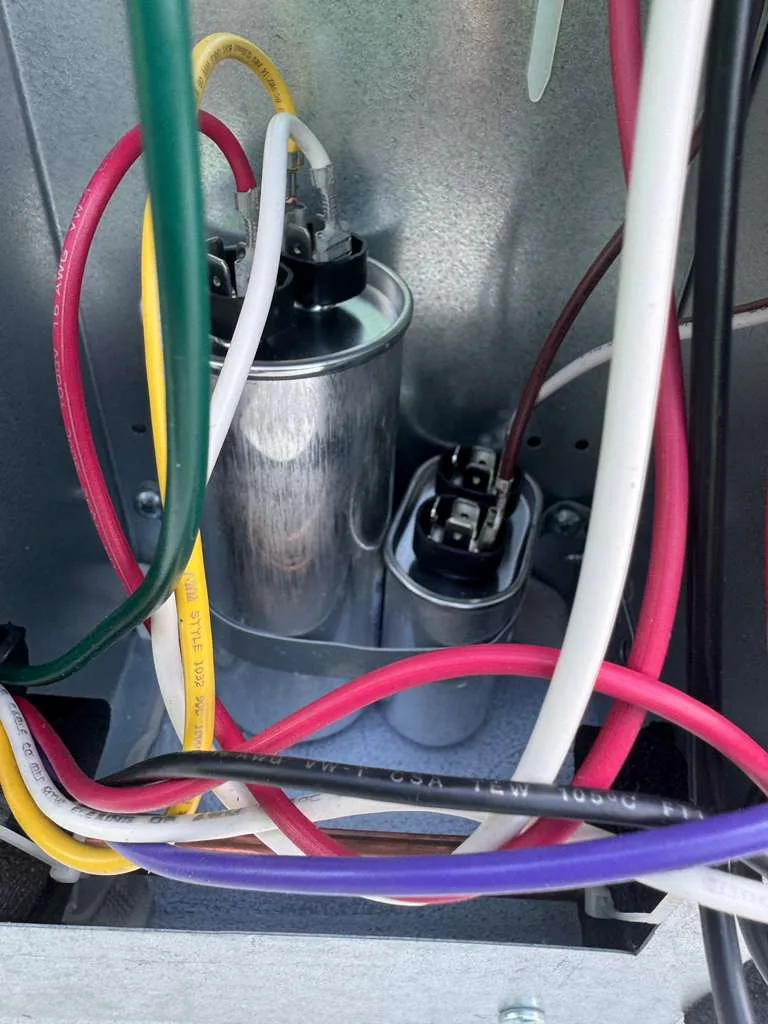
Because the fan and the compressor are separate loads, and only one of them has failed.
A rooftop unit has a fan motor and a compressor, each with its own winding and usually a shared capacitor with two sections. The fan section commonly survives while the compressor section degrades, so the unit sounds exactly as it always did while producing nothing but moved air.
That is why a capacitor is the first thing measured rather than the last. It is a cheap part, it is reachable from the roof, and it accounts for a large share of the warm-air calls we run through a Florida summer.
The second candidate is the compressor's start relay or hard-start assist. The third, and much less common, is the compressor itself, which is where the economics of the unit change entirely.
How much cooling should an RV air conditioner actually deliver?
A temperature difference rather than a target number, and that distinction settles most arguments about whether a unit is faulty.
A healthy rooftop unit pulls the air passing through it down by a substantial margin against what it is drawing in. The way to check it is to measure at the return grille and at a supply vent and compare the two, not to look at what the thermostat claims the room is.
That matters here because on a July afternoon a perfectly healthy unit can be doing everything it is rated to do and still not reach a comfortable interior. Nothing is broken; the load has exceeded the capacity.
Which is why the useful diagnostic question is never "is it cold enough" but "is the difference across the unit what it should be".
What does a dirty coil do to performance?
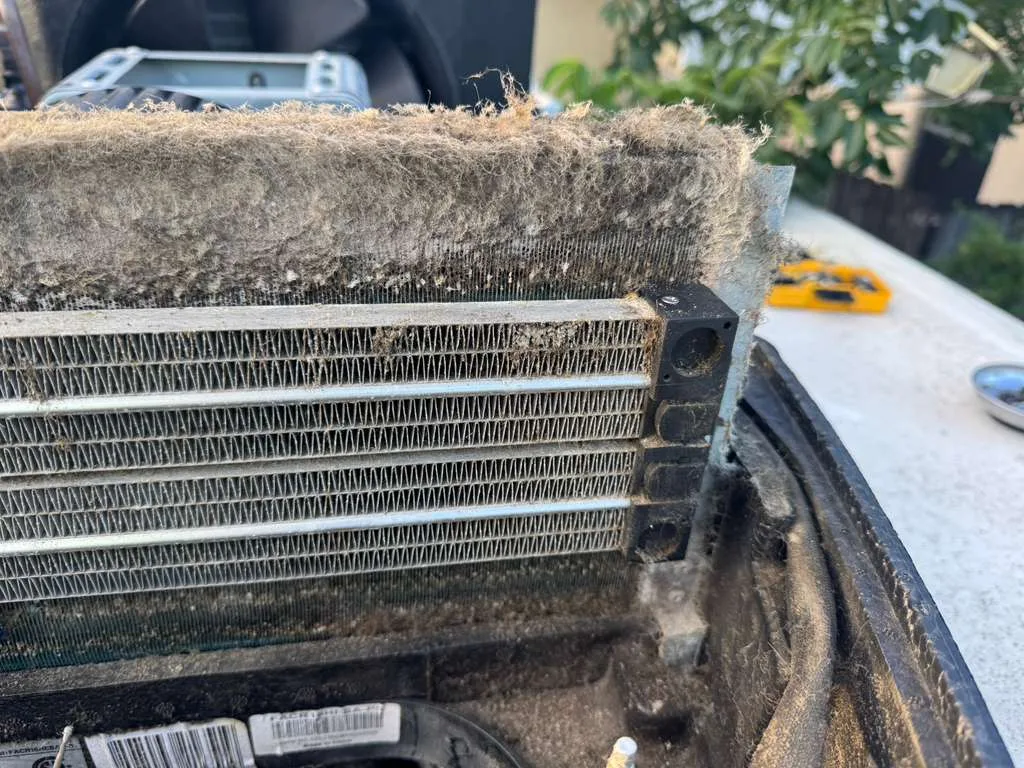
It quietly removes a large fraction of the unit's capacity without producing any symptom that looks like a fault.
The condenser coil on the roof rejects heat to the outside air, and it can only do that if air passes through it freely. Pollen, dust, cottonwood and road grime pack into the fins until the unit is effectively running in still air, and its high-side pressure climbs.
The consequences arrive in order: worse cooling, then longer run times, then a compressor working harder and hotter than it was designed to. Coil cleaning is maintenance rather than repair and it is the cheapest thing on this page.
The filter at the return grille inside does the same job in the other direction and is even easier to neglect. Owners are often surprised how much cooling a clean coil gives back on a unit they had written off.
Why do RV air conditioners freeze up?
Because the evaporator is not getting enough air across it, and ice forms on a coil that cannot shed its own cold.
The usual causes are a blocked return filter, a fan running slowly, closed or restricted supply vents, or simply running the unit continuously on the coldest setting in very humid air. Florida supplies the humidity for free.
The tell is that cooling gets worse and worse and then stops, rather than stopping suddenly, and there is visible ice on the coil when the cover comes off. Switching to fan only for a while clears it, and that is a diagnosis rather than a repair.
A unit that freezes repeatedly after the airflow has been corrected is reporting something else, usually a refrigerant or fan speed problem, and at that point it needs looking at properly.
Is a heat pump the same as air conditioning in reverse?
Mechanically yes, and practically it has one limitation that catches owners out every winter.
A heat pump moves heat from outside to inside by reversing the refrigerant flow, and it is efficient while there is heat outside to move. Below a certain outdoor temperature there is not enough, and the unit stops being able to help however long it runs.
That threshold is well above freezing, so on a cool Florida morning a perfectly healthy heat pump can be delivering very little. The coach then depends on its furnace, which is a different appliance with a different fuel and its own failure modes.
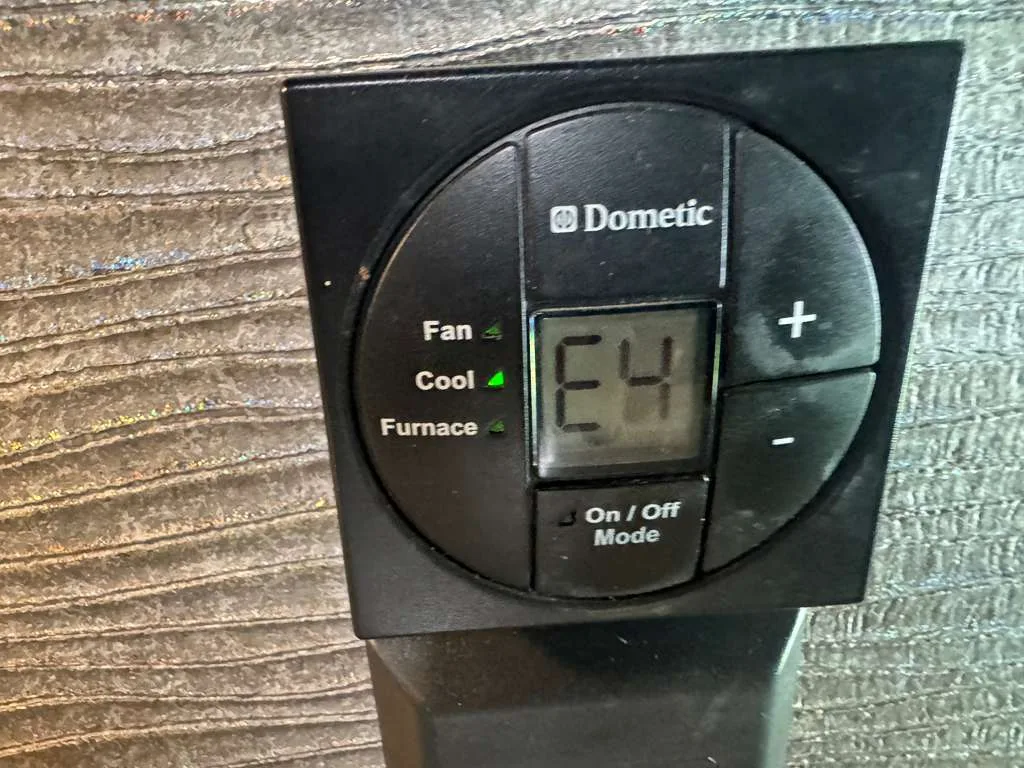
Most heat pump complaints we see turn out to be the thermostat, the wiring behind it, or the changeover logic rather than the unit on the roof. Knowing which of the two is actually running explains most of the complaints we hear about weak heat.
Should a failing unit be repaired or replaced?
It turns on which component failed and on how old the unit is, and only one failure genuinely forces the decision.
Capacitors, fan motors, relays, thermostats and control boards are all replaceable and worth replacing on almost any age of unit. None of them is close to the value of the appliance and all of them are done at the coach.
A failed compressor is the one that changes the arithmetic. On an older unit that is normally the point at which a replacement makes more sense, particularly since a newer unit is quieter and often more efficient for the same roof opening.
The other reason owners replace rather than repair is capacity. A coach that has never quite coped in July is a candidate for a larger unit or a second one, and that is a planning decision rather than a repair.
What does Florida specifically do to rooftop units?
It runs them for months at a time, in salt air, under continuous ultraviolet, which ages every part of them at once.
Run hours are the first factor. A unit in this state does more work in one season than the same unit does in several years further north, and capacitors and fan motors wear on run hours rather than on the calendar.
Salt air is the second, and it attacks the coil fins and the electrical connections on coaches kept near either coast. Corroded fins lose heat transfer before they look obviously damaged.
Ultraviolet is the third, and it is what cracks the shroud on the roof. A cracked shroud lets water into places it should never reach, which turns an air conditioning problem into a roof problem. All three run at once here, which is why units age faster in this state than their hour count suggests.
What can you check before calling us out?
Four things, and any of them can save a service call entirely.
Check the return filter and clean it. Check that supply vents are open and unobstructed, because a coach with half its vents closed starves the evaporator. Then measure the difference between return air and supply air rather than judging by feel, which is unreliable in high humidity.
Finally, check what the unit is running on. A rooftop air conditioner starting on a generator or a marginal pedestal draws a large surge, and low voltage at startup damages compressors over time. Our AC troubleshooting guide covers the sequence in more detail.
If those are all clear and it still blows warm, it is very likely the capacitor, and that is a straightforward visit. None of those four checks requires tools beyond a thermometer, and together they resolve a good share of calls.
What Does Mobile RV AC and Heating Repair Cost?
These are typical ranges for mobile service across Florida. A brief description of what's included is in the Notes column.
| Service | Typical Range | Notes |
|---|---|---|
| Service call (trip + 1st hour diagnosis/labor) | $299 - $399 | All-in for getting us to your site + first hour on any job. Exact rate confirmed at booking; varies by location. |
| Start capacitor replacement | $85 - $195 | Most common warm-air complaint; done at the coach |
| Fan motor replacement | $175 - $395 | Separate from compressor; often diagnosed same visit |
| Coil cleaning (condenser + evaporator) | $95 - $185 | Highest-value preventive service on any unit |
| Thermostat / control board | $150 - $380 | Covers most erratic-cycling complaints |
| Soft start device (installation) | $160 - $310 | Reduces starting surge; helps on generators |
| Compressor replacement | $650 - $1,800 | Rare but real; may favor full-unit swap on older rigs |
| Full rooftop unit swap (install) | $1,100 - $2,600 | Parts + labor; opening inspection included |
| Furnace service / ignitor | $155 - $420 | Propane furnaces serviced separately from AC unit |
Service call (trip charge + first hour) is $299-$399 depending on location - confirmed when you book. Repair line items below are national averages for mobile service (2025 data) and represent labor + parts after the first hour. Call (888) 702-6880 for an exact quote.
Air conditioning questions RV owners ask us
Can I run two rooftop units on a 30 amp hookup?
Not both at once, and not reliably. A thirty-amp supply is a single circuit and two compressors starting on it will trip the pedestal. Coaches with two units are normally fifty-amp; running one at a time on thirty is the workaround, and an energy management system automates it.
Why does my AC trip the breaker when it starts?
Because the compressor's starting surge is several times its running draw, and anything that raises that surge, such as a weak capacitor or low supply voltage, pushes it past the breaker. A soft start device reduces the surge and is a common fix on coaches at marginal sites.
How often should the coils be cleaned?
Annually at minimum in this climate, and more often for a coach parked under trees or near the coast. It is the single highest-value maintenance item on the unit and it does not require any parts.
Is a soft start worth fitting?
On most coaches yes. It reduces the starting surge enough to run a rooftop unit on a smaller generator or a weaker pedestal, and it takes stress off the compressor every time it starts, which matters over a Florida summer of daily cycling.
My thermostat reads the wrong temperature. Does that matter?
Yes, because the unit is controlled by what the thermostat believes rather than what the coach feels. A sensor reading high runs the unit continuously; one reading low short cycles it. Both are fixable and neither means the air conditioner is faulty.
Can you replace a rooftop unit at a campground?
Yes, and most replacements are done exactly there. The old unit comes off the roof, the opening and gasket are inspected and the new one is bedded and connected. What we need is a dry day, since the roof opening is briefly exposed.
Sources
- Dometic Penguin II - service manual - Manufacturer specification for capacitor values, airflow and expected temperature difference.
- Dometic - rooftop air conditioner documentation - Installation and service documentation for the common rooftop units fitted to coaches.
- Airxcel - RV climate brands - Documentation for the Coleman-Mach and related rooftop units and their controls.
- AHRI - air conditioning and heating industry standards - Industry body for the performance ratings behind heat pump output and temperature-difference expectations.