RV Water Damage Repair Across Florida
By the time a floor feels soft, the water has been there for a long time. The job starts with finding out how far it went, not with cutting.
Water damage in an RV is always larger than the part you can see. Water enters at a seam or a fitting, travels along a rafter or down inside a wall, and collects somewhere lower. So the first step is a moisture survey with recorded readings, which maps how far the wet area actually extends before anything is opened or quoted.
How do you find out how far the damage goes?
With a moisture meter and a map, before anything is opened, because opening at random tells you very little and costs a great deal.
Readings are taken in a grid across the floor, the lower walls, the ceiling and around every roof fitting. Dry material reads consistently low. A wet area reads high and, crucially, the readings fall away gradually at its edges, which is how the extent gets drawn.
That map does two things. It tells us where the water is now, and the upper edge of it points back toward where the water came in, which is usually somewhere nobody suspected.
It also produces a record. Recorded readings are evidence, which matters if any of this ends up going to an insurer, and they let the same measurements be repeated after the repair to prove it is dry.
What actually rots in an RV, and in what order?
The wooden structure inside the sandwich, and it goes in a predictable sequence that helps date the damage.
Walls and floors in most coaches are a laminated sandwich: an outer skin, a foam core, a wooden frame and an inner panel. Water that gets inside is trapped between two skins with nowhere to evaporate, which is exactly the condition wood does not survive.
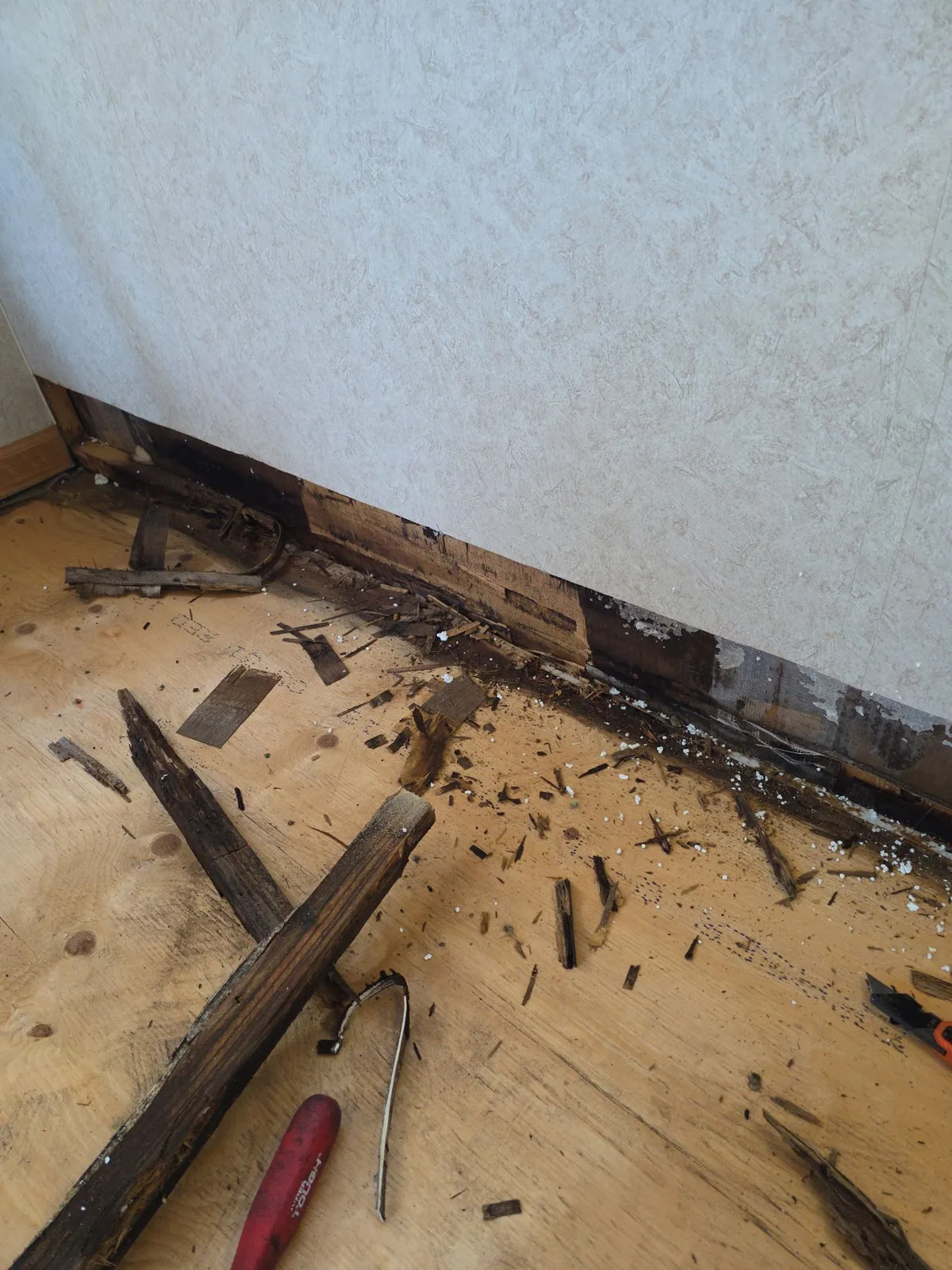
The subfloor goes first where water collects, usually at the lowest point along a wall or under an entry step. Wall framing follows, then the inner panel delaminates from the frame it was bonded to.
The outer skin is often the last to show anything, which is why a coach can look perfect from the outside while the wall behind the skin has failed. Delamination visible as a bubble in the sidewall is a late-stage symptom rather than an early one.
Can a soft floor be repaired without replacing the whole thing?
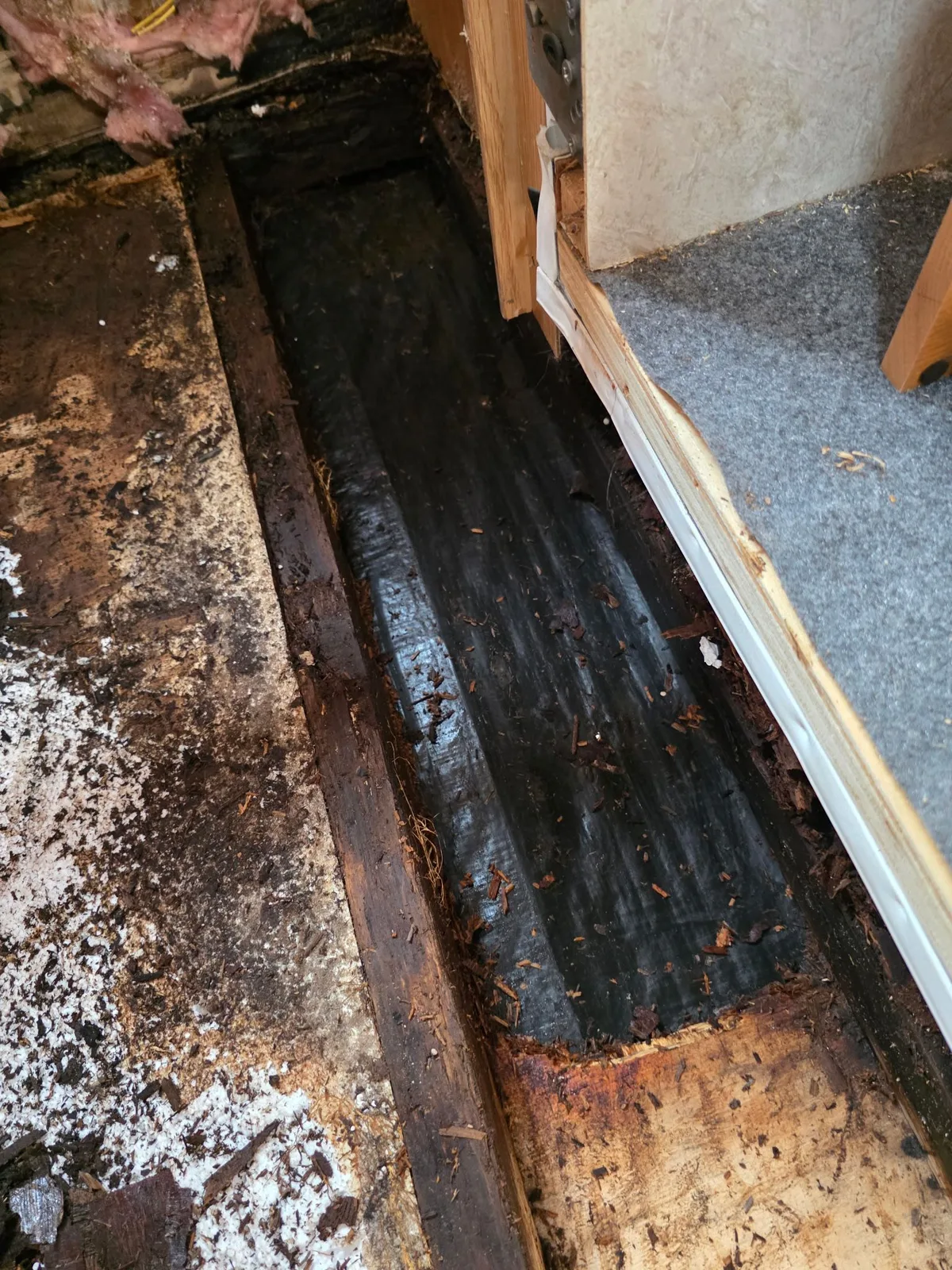
Usually yes, provided the section is cut back to genuinely sound material rather than to where the damage stops being obvious.
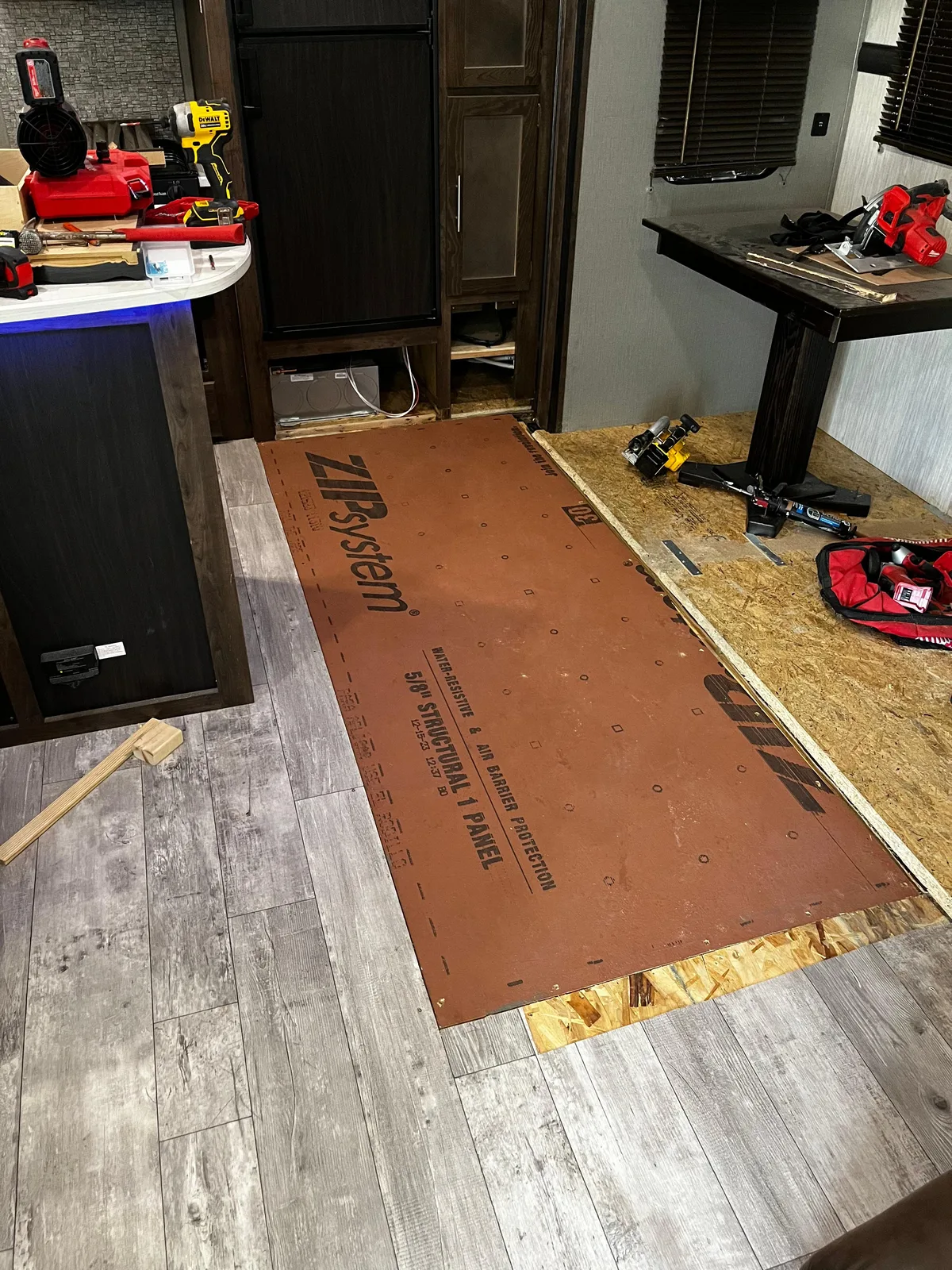
A localized repair means removing the affected subfloor, checking the frame members underneath, replacing what has gone and bonding new material in. Done properly it is indistinguishable afterwards and it lasts.
The mistake that produces a repeat failure is stopping at the visibly bad part. Wood that reads wet but still feels firm will continue to degrade, and covering it with new flooring simply hides the next stage.
That is why the meter matters more than the feel. The cut line is drawn from readings rather than from where the material happens to give underfoot. A repair drawn from readings costs a little more today and does not have to be done twice, which is the only comparison that matters on a floor.
Where does the water usually come in?
The roof and its fittings first, then windows and the entry door, then the plumbing, in roughly that order of frequency.
Every roof penetration is a hole cut through the membrane and sealed around, and that sealant is a consumable in this climate. The air conditioner, the vents, the skylights and the antenna mounts are all candidates, and the seam where the front or rear cap meets the roof flexes every mile.
Windows and the entry door are next. Their frames are bedded in butyl that hardens with age, and water then runs behind the frame and down inside the wall where nothing is visible.
Plumbing is third and behaves differently: it produces a wet area with no path from the roof, which is a useful distinction. Our plumbing service covers finding those. Establishing which of the three it is changes the whole repair.
What does Florida humidity do to a damp coach?
It stops it drying out, which turns a one-off leak into continuing damage.
In a drier climate a wall that got wet has some chance of losing that moisture between events. Here the ambient air is carrying so much water for so much of the year that a wet cavity simply stays wet, and the wood inside it never gets the dry spell it needs.
That is also why mold follows water damage so reliably in this state. The conditions for growth are present continuously rather than occasionally, and a sealed coach standing in a storage lot is the worst case of all.
It changes the repair too. Drying a structure here needs active dehumidification rather than open windows and patience, and confirming it is dry needs a meter rather than a judgment. It is also why a leak found in the spring is usually worse than the same leak found in the autumn.
Is water damage covered by insurance?
It turns on whether the cause was sudden and accidental or gradual, and that is a question of evidence rather than opinion.
Storm damage, impact and a fitting that failed abruptly are usually covered. A seam that has been degrading for two seasons and finally let water through is usually not, because policies exclude gradual deterioration and lack of maintenance.
What decides it in practice is documentation. Dated photographs of the roof and its sealant, records of resealing work, and a moisture survey taken at the time of discovery all support a sudden-cause account.
Nothing supports it after the fact if none of that exists, which is the real argument for having the roof inspected on a schedule rather than after a stain appears. A survey costs very little against the size of the claim it can support, which is the practical argument for doing one early.
When is a coach not worth repairing?
When the damage has reached the structure across a large area, or when the cost approaches what the coach is worth to its owner.
A localized floor section, a wall panel or a single delaminated area are all straightforward repairs with a long life. Those are worth doing on almost any coach somebody intends to keep.
The point where the answer changes is a sidewall that has failed along its length, a roof whose decking is soft across several rafters, or damage at a corner where the wall, floor and roof all meet. Those are structural rebuilds rather than repairs.
We would rather say that plainly at the survey stage than discover it halfway through. The moisture map is what makes that conversation possible before any money is committed. That is a conversation about your coach and your plans for it rather than a rule we apply.
What are the signs before a stain appears?
Smell, feel and fasteners, and all three come well before anything discolors.
A musty note in a coach that has been closed up is water in the insulation, and it is the earliest sign there is. Owners tend to attribute it to the coach being shut, which is exactly why it gets ignored.
Feel is the second. A floor with any give underfoot, a wall that flexes when pressed, or a window frame that moves are all structure that has softened. Screws backing out of a wall or a ceiling panel indicate the material they were driven into has lost its grip.
Our warning signs guide covers all of them, and our roof service is where most of them start. Acting on any one of the three is what keeps this a repair rather than a rebuild.
What Does Mobile RV Water Damage Repair Cost?
These are typical ranges for mobile service across Florida. A brief description of what's included is in the Notes column.
| Service | Typical Range | Notes |
|---|---|---|
| Service call (trip + 1st hour diagnosis/labor) | $299 - $399 | All-in for getting us to your site + first hour on any job. Exact rate confirmed at booking; varies by location. |
| Moisture inspection (pinless meter) | $95 - $195 | Full coach scan; written report |
| Dry-out and dehumidification | $250 - $750 | Commercial desiccant; 2-4 days |
| Wall panel replacement (per section) | $380 - $1,100 | Filon or TPO interior skin |
| Subfloor repair (per 8 sq ft section) | $320 - $950 | Luan or plywood; above-frame only |
| Soft-wall delamination repair | $500 - $1,800 | Injection or section replacement |
| Full water-damage restoration | $2,000 - $8,000+ | Floor to ceiling; scope varies widely |
Water damage is the highest-variance repair category. Scope — and cost — are determined by the moisture inspection. Call for a same-week inspection: (888) 702-6880.
Service call (trip charge + first hour) is $299-$399 depending on location - confirmed when you book. Repair line items below are national averages for mobile service (2025 data) and represent labor + parts after the first hour. Call (888) 702-6880 for an exact quote.
Water damage questions RV owners ask us
Can you do a moisture survey without opening anything?
Yes, and that is the point of it. The meters read through surface materials, so the map is produced non-destructively. Anything that does get opened afterwards is opened in the place the readings indicated rather than exploratively.
How long does a floor repair take?
A localized section is typically a few days including drying time, and the drying is what sets the pace rather than the carpentry. Rushing that step is what causes a repair to fail, because sealing new material over damp framing simply restarts the process.
Does delamination always mean water damage?
Not always - it can also come from a bond failure or impact - but water is the usual cause and it should be ruled out first with a meter. Delamination with high readings behind it is water damage that has reached a late stage.
Is mold in an RV dangerous?
It is a health question rather than only a cosmetic one, and it is treated as such. What matters is removing the moisture source rather than cleaning the visible growth, because anything left damp will regrow within weeks in this climate.
Should I buy a used RV with a soft spot in the floor?
Only with a moisture survey first and the result priced into the offer. A soft spot is the visible end of something larger, and the difference between a localized repair and a structural rebuild is not visible from the doorway.
Can you repair water damage at my site rather than a shop?
Most of it, yes. Surveys, localized floor sections, wall panels and the leak repair itself are all done where the coach is. A structural rebuild is the exception, and we will say so rather than starting something that cannot be finished there.
Sources
- EPA - mold and moisture - Guidance on moisture control and why removing the source matters more than cleaning the growth.
- InterNACHI - inspection standards - Inspection practice for moisture intrusion and structural assessment.
- Dicor - sealant installation instructions - Manufacturer specification for the roof sealants whose failure causes most of this damage.
- National Weather Service - Tampa Bay - Regional humidity and rainfall, which is why a wet cavity here does not dry out on its own.