RV Interior Repair and Renovation Across Florida
Flooring, cabinets, wall panels, countertops and furniture. Most interior work is straightforward - what makes it fail is starting before the structure underneath has been checked.
Interior work in a coach is not the same job as interior work in a house, for two reasons: the structure moves, and everything added has to be carried for the life of the vehicle. The most common mistake is fitting new flooring or cabinetry over a subfloor that has already softened, which hides the real problem and has to be done twice.
What has to be checked before any interior work starts?
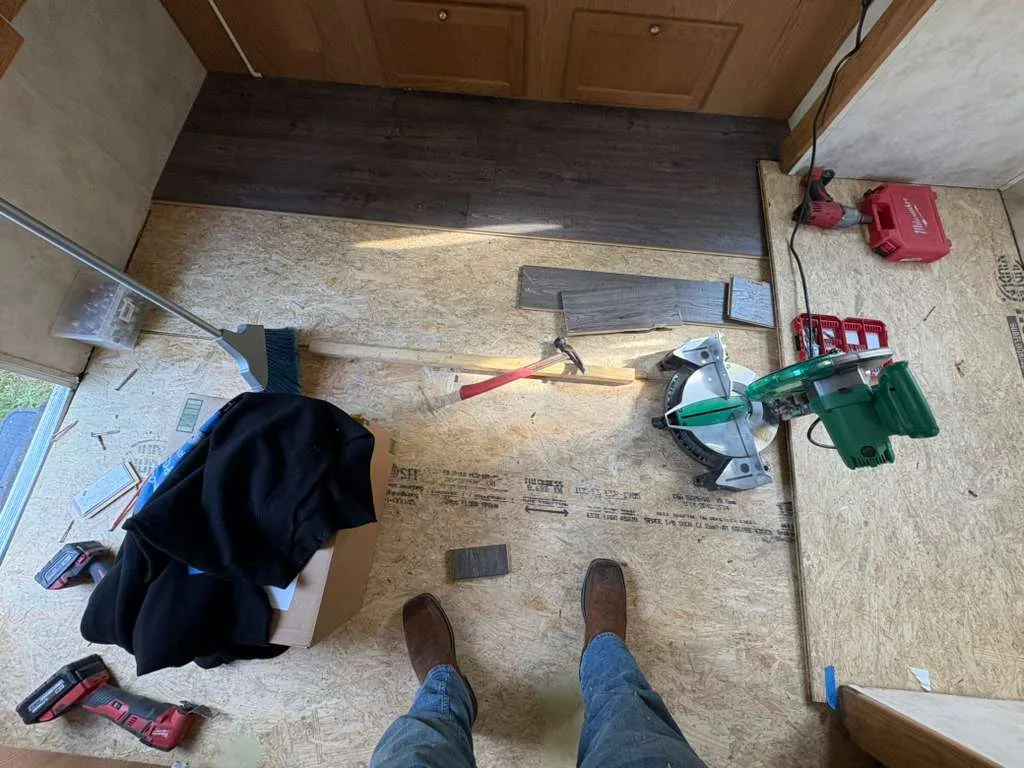
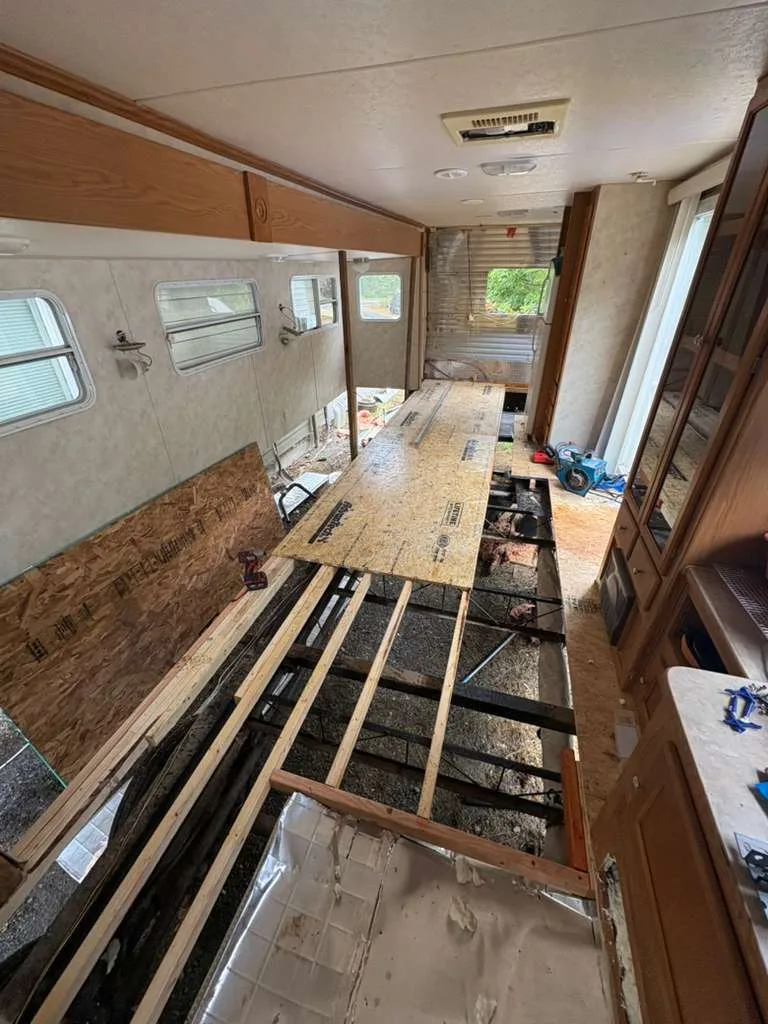
Whether the structure under it is dry and sound, because everything else is decoration over that answer.
A moisture survey across the floor and the lower walls takes very little time and settles it. Dry readings mean the interior work is genuinely interior work. High readings mean there is a structural repair to do first, and the finish is the last stage of it rather than the whole job.
The reason this matters so much is that new flooring seals a damp subfloor in rather than letting it dry. The material continues to degrade under a surface that now looks perfect, and the second repair costs everything the first one did plus removing it.
Cabinets that have gone soft at the base, and wall panels that flex when pressed, are the same story further up. Our water damage service covers what happens when the answer is not dry.
What flooring actually works in an RV?
Vinyl plank and sheet vinyl for most coaches, and the decisive properties are weight and tolerance of movement.
A coach flexes as it travels and expands and contracts through a Florida temperature range. Flooring laid with no allowance for that buckles at the seams or lifts at the edges, which is why a floating installation with a proper perimeter gap outperforms one glued rigidly wall to wall.
Weight is the second consideration. Tile is heavy, it is rigid, and it cracks along a grout line the first time the coach twists on an uneven site. It appears in coaches and it rarely stays intact.
Carpet is the third option and it is the one Florida argues against hardest. It holds moisture, it holds humidity, and in a coach that spends months closed up it is where a musty smell begins.
Can cabinets and furniture be repaired rather than replaced?
Usually yes, because what fails is the fastening and the facing rather than the structure of the unit.
Cabinet doors that no longer sit square, drawers that will not stay closed on the road and shelves that have dropped are nearly always hinges, catches and screw fixings that have worked loose over thousands of miles. All of those are replaceable in place.
Facing is the other common failure. The thin laminate on cabinet fronts lifts at the edges with heat and humidity, and it can be re-bonded or refaced without touching the carcass behind it.
The unit itself only needs replacing when its base has been wet, which brings the conversation back to the structure underneath rather than the cabinetry. Repairing hardware rather than replacing units also keeps the coach looking like itself, which matters more to most owners than a new finish would.
What is different about RV countertops?
They have to be light and they have to tolerate cabinets that move relative to one another, which rules out most of what a kitchen showroom recommends.
Solid surface is the strongest all-round answer: light for its stiffness, seamable, and repairable in place, which matters in something that gets knocked by cookware in transit. Laminate on a lightweight core is the value option and is not a compromise if the substrate is right.
Stone is the one most often regretted. It is heavy, it is rigid, and a rigid slab spanning cabinets that move will crack - almost always at the narrowest point, which is the corner of the sink or cooktop cutout.
The other reason galley work grows is that lifting a countertop is when a long-running sink leak in the cabinet below finally gets found.
Why do wall panels bubble or come away?
Because the panel is bonded to the frame behind it, and either the bond or the frame has failed.
Interior panels in most coaches are thin material bonded to a wooden frame within a laminated wall. Heat and humidity work on that adhesive continuously, and a panel that has begun to lift at a seam is reporting the bond.
A panel that bulges, however, is usually reporting the frame. Wood that has been wet swells, and the panel bonded to it has nowhere to go but outward. That is a water problem presenting as a cosmetic one.
So a bubbling panel gets a meter put on it before it gets re-bonded. Re-bonding a panel to swollen framing lasts until the framing moves again, which it will. A meter costs nothing to use and it is the difference between a repair that holds and one that repeats.
What does Florida do to an RV interior?
Humidity works on the adhesives and the soft furnishings, and heat works on everything bonded or laminated.
A coach closed up through a summer here reaches interior temperatures that soften adhesives and drive moisture into anything absorbent. That is why laminate edges lift, why panel bonds fail and why upholstery and mattresses grow mold in coaches that were perfectly dry when they were parked.
Ultraviolet through the windows fades and embrittles fabric, blinds and dash surfaces, and it does it faster than owners expect. Reflective covers in the windscreen are cheap and genuinely effective.
The countermeasure for all of it is the same as for storage generally: dehumidification or ventilation, and not leaving the coach sealed and unattended for months at a time. A coach used regularly through the year suffers far less of this than one parked and shut for a season.
How much weight does a renovation add?
Enough to matter, which is why the decision is made against the weight placard rather than against a sample board.
Every coach has a difference between what its chassis is rated to carry and what it already weighs, and that margin is what you are allowed to load. It is frequently smaller than owners expect once water, batteries and belongings are counted.
Flooring, countertops and tile are the three that consume it quickly, and countertops and cabinets sit high and to one side, which affects handling more than the same weight low down between the axles.
The honest check is an actual weighed figure rather than an assumption. A coach that has never been over a scale is one where nobody knows how much margin is left. Weighing a coach once is inexpensive and it informs every decision after it.
Is an interior renovation worth doing on an older coach?
It depends entirely on whether you intend to keep it, because this is comfort spending rather than investment.
On a coach that is sound underneath and that somebody plans to live in or travel in for years, new flooring and a refreshed galley change the experience of using it more than almost anything else for the money. Full-timers notice it daily.
It returns very little at resale beyond making the coach easier to sell at all. That is not an argument against doing it; it is an argument against doing it as a way of adding value.
The one case where we would say no is a coach with structural water damage. There the money belongs in the roof and the floor first, and the interior last. Spending it the other way round is the most common regret we see in this work.
What Does Mobile RV Interior Repair Cost?
These are typical ranges for mobile service across Florida. A brief description of what's included is in the Notes column.
| Service | Typical Range | Notes |
|---|---|---|
| Service call (trip + 1st hour diagnosis/labor) | $299 - $399 | All-in for getting us to your site + first hour on any job. Exact rate confirmed at booking; varies by location. |
| Flooring repair / section (vinyl or laminate) | $220 - $680 | Damaged section; full floor priced separately |
| Window shade / blind replacement | $95 - $280 | Day-night shade; per unit |
| Window regulator / crank | $110 - $320 | Frameless or slide-out windows |
| Cabinet latch, hinge, or handle | $45 - $145 | Per unit; hardware supplied |
| Dinette / bed mechanism | $165 - $520 | Fold-out conversion hardware |
| Interior LED lighting upgrade | $185 - $550 | Full coach LED swap; circuit checked |
| Ceiling fan or vent fan swap | $120 - $380 | 12V fans; Fantastic or MaxxAir |
Service call (trip charge + first hour) is $299-$399 depending on location - confirmed when you book. Repair line items below are national averages for mobile service (2025 data) and represent labor + parts after the first hour. Call (888) 702-6880 for an exact quote.
Interior questions RV owners ask us
Can interior work be done at my site?
Most of it. Flooring, cabinet repairs, panel work and countertop replacement are all done where the coach is parked. What we need is space to work and somewhere to put what comes out, which a campsite or a storage bay usually provides.
How long is the coach unusable during a floor replacement?
A localized section is days rather than weeks, and the drying time on any damp material sets the pace. A full-length floor is longer because everything standing on it - furniture, and sometimes cabinetry - has to come out first.
Can I put a residential washer or dishwasher in?
Sometimes, and the constraints are weight, water supply and drainage rather than space. RV water pressure and gray tank capacity are both lower than a house, so an appliance sized for a home fills the tank faster than owners expect.
Why do my cabinet doors keep coming open on the road?
The catches have worn or the door has dropped slightly on its hinges, so the catch no longer engages fully. Both are quick fixes. It is worth doing promptly because a door that opens in transit usually takes its contents and sometimes its hinge with it.
Is vinyl plank suitable for a slide-out floor?
Yes, with attention to the transition where the room meets the main floor. That joint moves every time the slide operates, so it needs a transition strip designed for movement rather than a rigid one glued across the gap.
Should I replace the flooring before or after fixing a leak?
After, always, and after the structure has been confirmed dry. New flooring over damp material is the single most common repeat repair in this trade and it costs the whole job twice.
Sources
- Lippert Components - master manuals - Manufacturer documentation for the cabinetry, framing and interior structure of most coaches.
- 49 CFR - federal motor vehicle regulations - The federal framework behind vehicle weight ratings and the placard figures that limit what a coach may carry.
- EPA - mold and moisture - Why soft furnishings and carpet in a sealed humid coach are the first things to grow mold.
- InterNACHI - inspection standards - Inspection practice for the moisture and structural checks that belong before interior work.