RV Storage Prep and Winterization Across Florida
In this state the risk is rarely ice. It is a coach sealed up warm and damp for six months, with water standing in every line.
Most Florida coaches do not need antifreeze. What they need is the water out of the system, the humidity controlled, the batteries looked after and the openings screened. The exception is the northern half of the state, which does drop below freezing, and a coach left full during a cold snap splits a fitting exactly as it would anywhere else.
Does an RV in Florida actually need winterizing?
It depends where in the state it sits, and the honest answer changes by a couple of hundred miles.
South of roughly Lake Okeechobee a hard freeze is rare enough that draining the system and leaving it dry is a reasonable position. North of Orlando, and particularly in the Panhandle, freezing nights arrive most winters and a coach left with water in its lines is genuinely at risk.
What matters is not the average but the one night. A single hard freeze splits a fitting, and the damage does not appear until the system is next pressurized, often months later, by which time water has been running into the floor.
So the sensible split is drain-and-dry in the south, full protection in the north, and a decision rather than a default in the middle.
What actually damages a coach left standing here?
Humidity, standing water and ultraviolet, in roughly that order, and none of them announces itself while it is happening.
A sealed coach in a Florida summer holds warm, damp air for months. That is what produces mold on soft furnishings, a musty smell that never quite leaves, and corrosion on electrical connections in bays nobody opens.
Standing water is the second. A full fresh tank and a full run of lines sitting at ambient temperature in the eighties is close to ideal for the growth that produces the taste and smell owners report on the first trip back.
Ultraviolet is the third and it works on everything outside: seals, tires, the roof membrane, the awning fabric and the slide toppers. All three are slow, none of them is visible on the day, and every one of them is preventable with an afternoon of preparation.
What does storage prep involve on the water side?
Emptying everything that holds water, and the parts owners forget are the ones that cause the trouble.
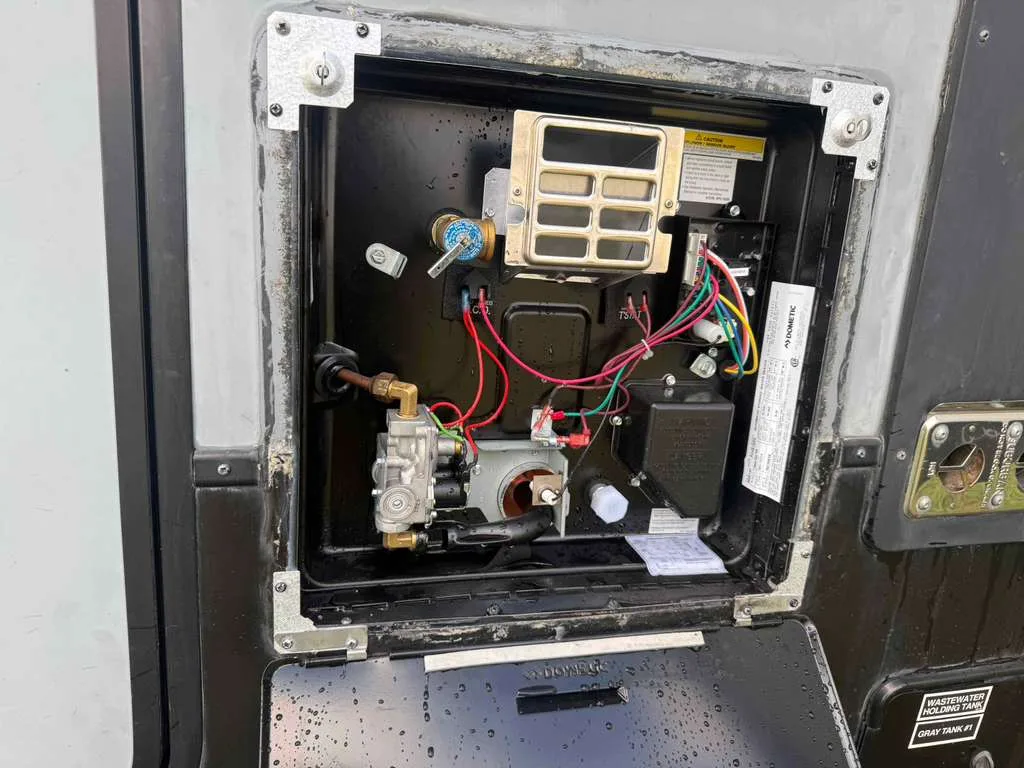
The fresh tank, both waste tanks, the water heater and the lines all get drained, and the low point drains are opened. The water heater is the big one: it holds the largest volume in the coach and it is routinely left full because its drain is awkward to reach.
The pump is run dry briefly to clear it, and the filter cartridge comes out rather than being left to sit wet for months.
Where the coach is going to be protected properly, antifreeze then goes in through the pump with the water heater bypassed. Filling the heater with antifreeze is a waste of several gallons and does nothing the bypass does not. Draining is also the point at which a leak that has been quietly running gets noticed, which is a useful side effect.
Why does sanitizing matter more here than antifreeze?
Because antifreeze stops water freezing and does nothing whatever to what grows in it.
The pink antifreeze sold for potable systems is a freeze depressant rated as non-toxic so traces are safe. It is not a disinfectant, and its residue is sweet and coats the inside of every line it passed through, which if anything feeds what is already there.
In a climate where the real risk is warm water standing still, the step that protects the system is a proper sanitizing cycle: a measured solution circulated to every outlet and left long enough to work, then flushed.
Contact time is what disinfects rather than concentration, so a weak solution left overnight beats a strong one rushed through in an hour. A system sanitized before storage and flushed on return is the one that does not taste of anything in the spring.
What should be done about humidity inside?
Give the moisture somewhere to go, or give the air somewhere to move, and preferably both.
A coach on shore power can run a small dehumidifier, which is the most reliable answer and the one that keeps soft furnishings usable. A coach in an unpowered lot depends on desiccant containers, which work but have to be emptied on a schedule that somebody has to actually keep.
Ventilation is the other half. Roof vents propped slightly open under covers let damp air escape rather than condensing on the coldest surface in the coach, which is usually a window frame or an outside wall.
Interior doors, drawers and the refrigerator all get left open for the same reason, and a fridge closed for six months is a smell nobody wants to meet again. Between a dehumidifier and a propped vent, most coaches come out of storage smelling of nothing at all.
What about batteries, tires and pests?
Batteries discharge, tires flat-spot and degrade, and pests move in, and all three are cheaper to prevent than to fix.
Lead-acid batteries left discharged sulfate and lose capacity permanently, so they are either kept on a maintainer or removed and stored charged. Lithium banks prefer to be left at a partial state of charge rather than full, and their manufacturer will state a figure.
Tires age on ultraviolet and ozone rather than on mileage. Covers, correct pressure and taking the weight off where practical all extend them, and a tire that has stood flat-spotted for months does not always recover.
Pests are the third. Screening the vents, the flue and the propane bay before storage prevents the nests that produce most of our spring gas appliance calls. Of the three, batteries are the most expensive to get wrong and the easiest to protect.
How should the outside be prepared?
Sealed, covered where sensible, and inspected first rather than after, because storage hides problems it did not cause.
The roof seams and every fitting get looked at before the coach goes away. A sealant bead that is already crazed will not survive six months of afternoon storms, and finding that now is far cheaper than finding the resulting stain later.
Awnings go away clean and dry. Rolling up a wet awning in Florida humidity produces mildew that is very difficult to remove and often ends the fabric.
Slide rooms are normally best brought in, both to protect the seals from ultraviolet and to reduce the surface collecting water and leaves. Our roof service covers the seal inspection in detail. Covers help with ultraviolet and hurt if they trap moisture, so a breathable one that actually fits is worth the difference in price.
What does bringing a coach back into service involve?
The reverse of the list, in the reverse order, and one step in particular has to happen before any water is heated.
The water heater comes off bypass and its drain plug or anode goes back in before the system is refilled. Switching an electric element on in a dry tank destroys it in seconds, and it is the most common recommissioning mistake there is.
Then the system is flushed until every outlet runs clear and stops foaming, sanitized, flushed again, and the filter cartridge goes back in last so it does not strip the disinfectant.
After that it is a working inspection: batteries, tires, gas pressure test, appliance function and a look at the roof. That is when problems that developed quietly in storage actually surface. Booking that inspection before the first trip rather than after is what turns a surprise into a scheduled repair.
What Does RV Winterization and Dewinterization Cost?
These are typical ranges for mobile service across Florida. A brief description of what's included is in the Notes column.
| Service | Typical Range | Notes |
|---|---|---|
| Service call (trip + 1st hour diagnosis/labor) | $299 - $399 | All-in for getting us to your site + first hour on any job. Exact rate confirmed at booking; varies by location. |
| Winterization (compressed air blow-out) | $95 - $185 | Blow-out method; tank valves cycled |
| Winterization (antifreeze method) | $125 - $245 | RV pink antifreeze; hand-pump or pump bypass |
| Dewinterization (spring flush) | $95 - $185 | Full flush, pressure test, water heater relight |
| Storage commissioning (full season prep) | $195 - $450 | Winterize + LP shut-off + tire/roof/battery check |
| Annual maintenance package | $285 - $620 | Seasonal service; covers most systems |
Service call (trip charge + first hour) is $299-$399 depending on location - confirmed when you book. Repair line items below are national averages for mobile service (2025 data) and represent labor + parts after the first hour. Call (888) 702-6880 for an exact quote.
Storage questions RV owners ask us
Can you do storage prep at my storage lot?
Yes, and that is where most of it happens. What we need is access to the coach and its bays. A lot with no water supply changes how the flushing is done but does not prevent the work.
Is blowing the lines out with air as good as antifreeze?
It is a reasonable method and it depends on doing it thoroughly. Air clears the runs but tends to leave water in traps, valves and low points, which are exactly the fittings that split. In the north of the state antifreeze is the more reliable belt-and-braces answer.
Should I leave the RV plugged in while stored?
It depends on the converter. A modern multi-stage unit will hold the batteries correctly indefinitely; an older single-stage one can cook them over months. If you do not know which you have, that is worth establishing before leaving it connected all season.
How often should a stored coach be checked on?
Monthly is a good habit even if nothing is done on the visit. Most storage damage is slow and reversible if it is caught early, and the things that go wrong - a failed maintainer, a torn cover, a nest starting - are all obvious to anyone who opens the door.
Do the waste tanks need to be empty for storage?
Empty and rinsed. A tank left with contents through a Florida summer bakes them onto the walls and the sensors, and clearing that afterwards is far harder than it would have been at the time. It is also the single biggest source of smell on return.
What is the one thing people forget most?
The water heater. It holds more standing water than anything else in the coach, its drain is awkward, and the bypass valves are frequently left wherever the last person put them. It causes both the freeze damage in the north and the smell everywhere else.
Sources
- Suburban - RV water heater manual - Manufacturer instructions for draining, bypassing and the anode rod before storage.
- Camco - RV antifreeze and storage products - Reference for potable antifreeze, tank treatments and storage accessories.
- EPA - moisture and mold - Why a sealed damp space is the condition that produces growth, which is the storage risk here.
- National Weather Service - Tallahassee - Freezing-night frequency in north Florida, which is what decides whether antifreeze is needed.