Mobile RV Plumbing Repair Across Florida
Fresh water, waste and the water heater between them. Most RV plumbing faults are found by pressure and sound rather than by looking, because the pipe is behind a wall.
Almost all RV plumbing runs behind panels and under floors, so a leak is found by pressure test and by listening rather than by looking. A pump that keeps cycling with every tap closed is the clearest single symptom there is: the system cannot hold pressure, and something is losing it. That test costs nothing and narrows the search immediately.
Why does the water pump keep cycling with no tap open?
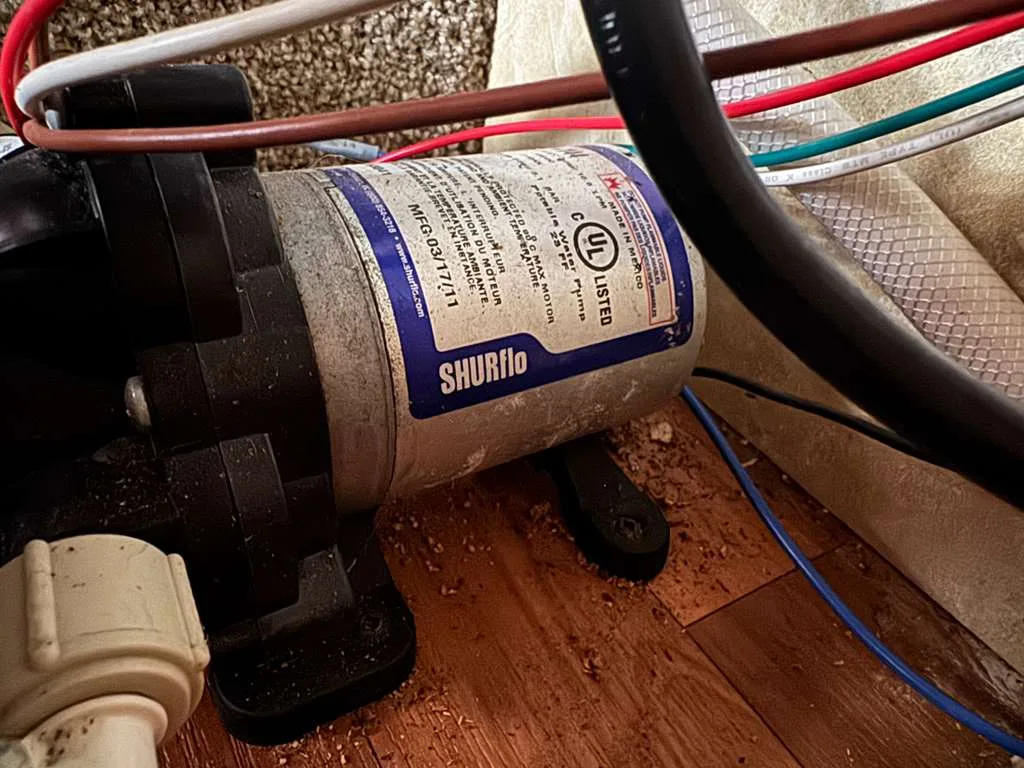
Because the system is losing pressure somewhere, and the pump is doing exactly what it was built to do about it.
A demand pump runs until it reaches its cut-off pressure and stops. If it starts again by itself, pressure has fallen, and with every fixture closed there are only three ways that happens: a leak, a failed check valve inside the pump, or a toilet valve passing water into the black tank.
The toilet is worth eliminating first because it is silent and it leaves no evidence anywhere you would look. Water passing into the tank is simply gone.
After that the search is a matter of isolating sections and watching whether the cycling stops, which is why this symptom is so useful. It turns an invisible problem into a bounded one. It is also the one symptom worth acting on immediately rather than living with.
How do you find a leak behind a wall?
By pressure and by meter, because opening panels at random is slow, destructive and usually wrong.
The system is pressurized and then isolated section by section. A section that holds is eliminated; a section that bleeds down contains the fault. That narrows a whole coach to a short run of pipe without removing anything, and it is the difference between a targeted repair and an exploratory one.
A moisture meter then finds where the water has collected. Readings taken across the floor and the lower walls map the wet area, and the leak sits at the upper edge of it because water runs down.
Only then does anything get opened, and it gets opened in one place rather than four. Our water damage service covers what happens when the leak has been running a while.
What goes wrong with RV water heaters?
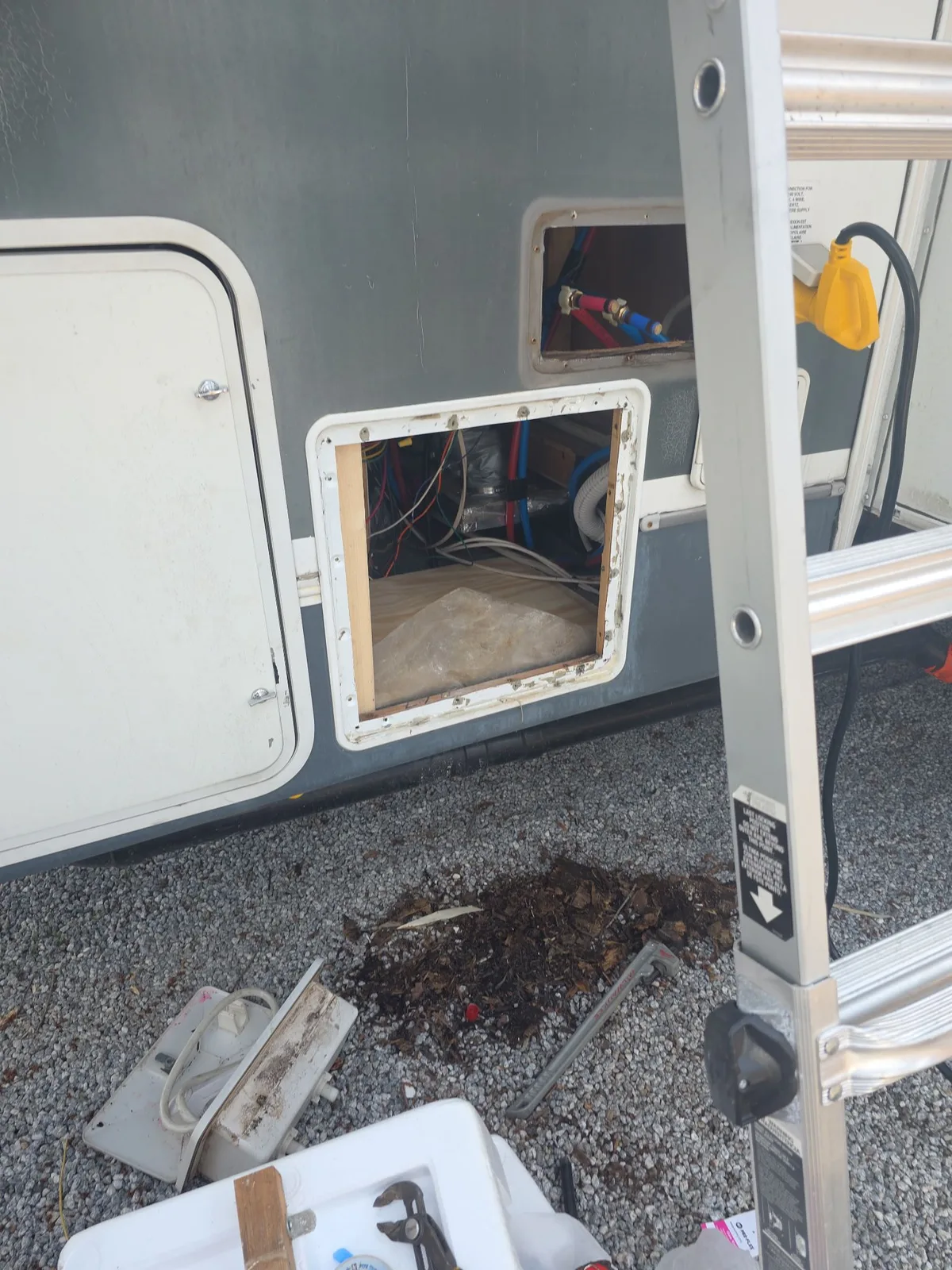
The element, the gas valve, the thermostat and the anode, and only rarely the tank itself.
A heater that works on gas but not electric, or the reverse, has told you which half to look at, because everything else is shared. On the electric side that is usually the element or its thermal cutout; on the gas side it is the igniter, the valve or a blocked burner tube, and insect nests in that tube are a seasonal certainty here.
The anode rod matters more than owners expect. In a steel tank it is a sacrificial part that corrodes so the tank does not, and one that has been left for years is no longer protecting anything.
Aluminum tanks do not take one, and fitting an anode to the wrong tank causes the damage it was meant to prevent.
Why does the water smell like rotten eggs?
Because bacteria in the tank or the heater are producing sulfide, and the heater is usually where it starts.
Warm water standing for weeks is close to ideal for the organisms that generate that smell, and a water heater left full through a Florida summer provides exactly those conditions. The smell is strongest at the hot tap, which is the clue that separates it from a fresh tank problem.
Flushing the heater, replacing a spent anode and sanitizing the whole system usually clears it. Doing only one of the three tends to bring it back within a few weeks.
If the smell is at the cold tap as well, the fresh tank and the lines are involved, and the fix is a proper sanitizing cycle with enough contact time rather than a stronger solution for less time.
What is different about RV plumbing compared with a house?
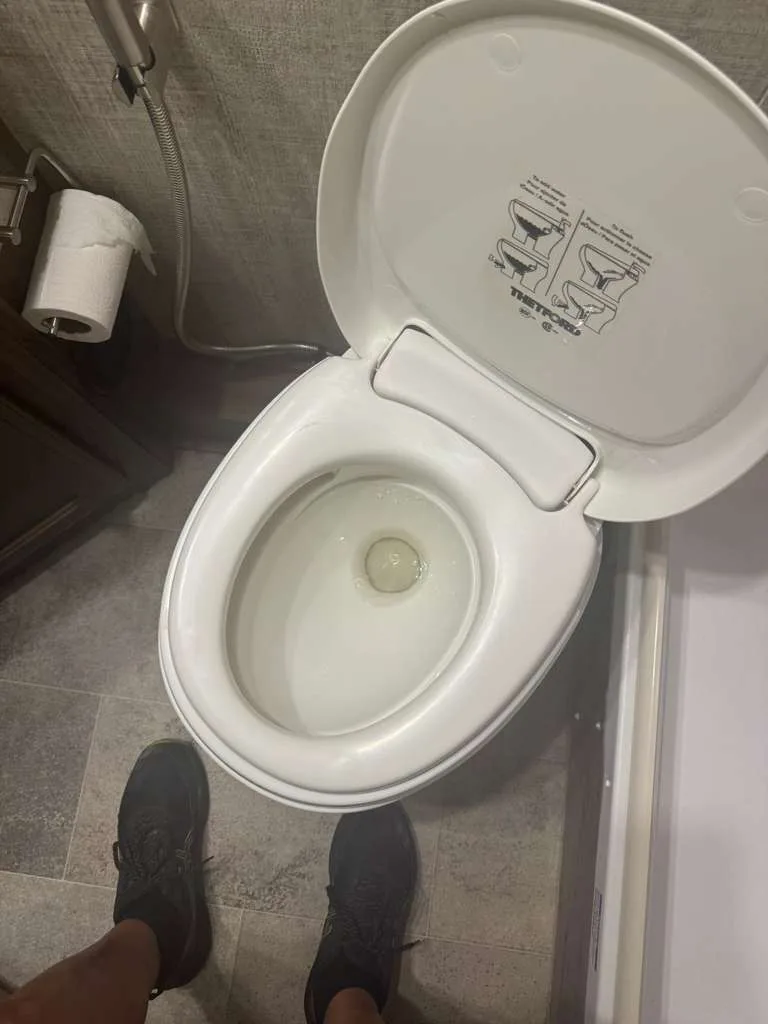
It moves, it runs at lower pressure, and its fittings only look like household ones.
Everything in a coach vibrates down the road, so joints work loose in a way house plumbing never does, and lines are routed to allow for that movement. A repair made rigid where the original was not simply moves the failure a few inches along.
Pressure is the second difference. Coaches are built for a much lower supply pressure than a house, which is why a regulator at the campground pedestal is not optional and why an unregulated hookup can split a line.
Third, the parts. Some household fittings thread onto RV components and then fail under vibration or crack in a cold snap, and drain fittings in particular are not interchangeable. Using the right parts is not fussiness here; it is the difference between a repair that lasts and one that fails on the next trip.
Why will the black tank not empty?
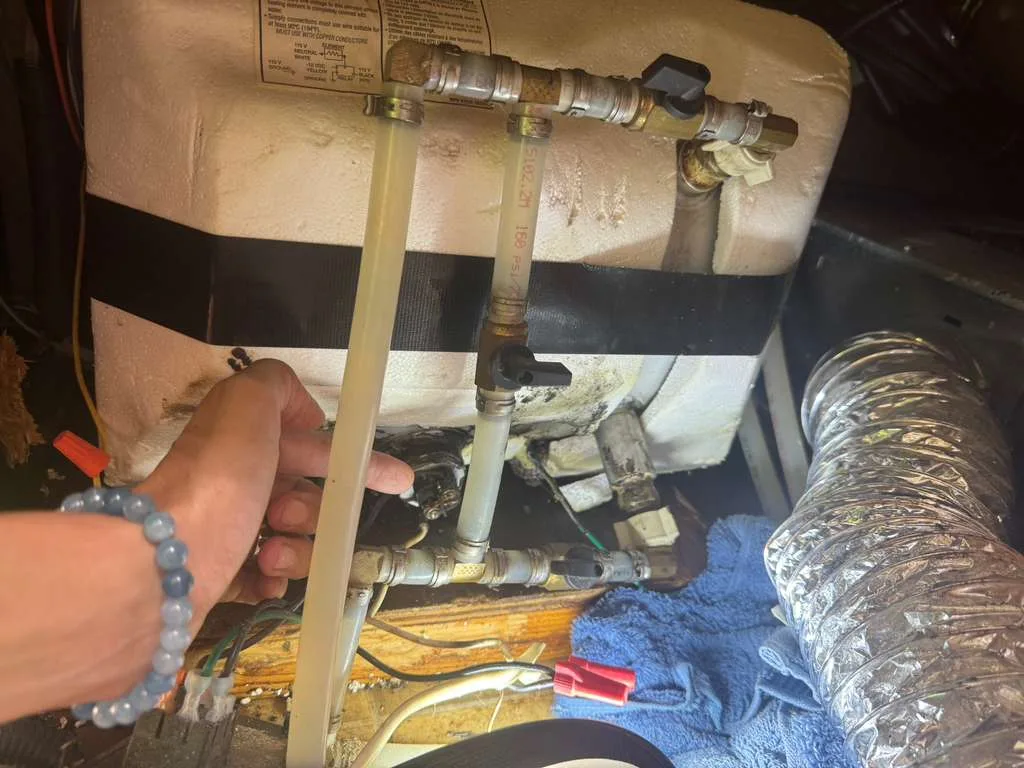
Either the tank is blocked or the valve is seized, and the two are told apart before anything is forced.
A blockage is nearly always the result of dumping at too low a level. Solids need a volume of liquid leaving quickly to carry them out, and a tank emptied at a quarter full leaves them behind to build up. Water and time dissolve that; nothing rigid should ever go down the toilet.
A seized valve is the different fault. The blade is gripped by dried seals rather than blocked, and pulling harder on the handle bends the rod or shears the blade off inside the housing.
That distinction matters because one of them clears itself overnight with the tank full, and the other becomes a replacement done from underneath. Dumping at two thirds full or more, and keeping the black valve closed on a hookup, prevents nearly all of it.
What does Florida do to RV plumbing?
It removes the freeze risk and replaces it with a worse one, which is warm water standing still.
A coach stored through the summer here has a full fresh tank and a full run of lines sitting at ambient temperatures in the eighties and nineties for months. That is what produces the taste and smell problems owners report on the first trip of the season, and it is why sanitizing matters more in this state than winterizing does.
Freeze is not zero, though. The northern half of the state does drop below freezing, and a coach left with water in its lines during a cold snap splits a fitting exactly as it would anywhere else.
The other local factor is water quality, which varies enough between counties that a filter is worth fitting and changing on schedule.
When does a plumbing leak stop being a DIY job?
When you cannot see the pipe, when the floor feels soft, or when the leak involves the water heater's gas side.
A visible fitting under a sink is a reasonable owner repair with the right parts. A line behind a wall is not, because finding it is the skilled part and opening the wrong panel costs more than the repair.
A soft floor changes the job entirely. At that point the water has been there long enough to reach the structure, and sealing the pipe no longer addresses what is actually wrong.
Anything involving the gas side of a water heater belongs to someone who will pressure test it afterwards. Our LP gas service covers that side and our damage guide covers the signs that come before a stain. Neither of those is a judgement about competence - it is about what the fault has already reached.
What Does Mobile RV Plumbing Repair Cost?
These are typical ranges for mobile service across Florida. A brief description of what's included is in the Notes column.
| Service | Typical Range | Notes |
|---|---|---|
| Service call (trip + 1st hour diagnosis/labor) | $299 - $399 | All-in for getting us to your site + first hour on any job. Exact rate confirmed at booking; varies by location. |
| Water pump replacement | $160 - $380 | 12V demand pumps; includes pressure adjustment |
| Water heater service / element | $140 - $360 | Anode rod, thermostat, or element; tank flushed |
| Water heater replacement (gas or electric) | $420 - $950 | Parts + labor; bypass winterize valve added |
| PEX / hose fitting repair | $85 - $245 | Single-joint repairs; labor per connection |
| Fresh tank vent or fitting | $95 - $280 | Gravity fill or vent line repairs |
| Black / gray tank valve replacement | $110 - $290 | Slide-valve or gate valve at tank outlet |
| Leak trace and repair (full coach) | $150 - $450 | Pressurization test + repair; multi-joint extra |
Service call (trip charge + first hour) is $299-$399 depending on location - confirmed when you book. Repair line items below are national averages for mobile service (2025 data) and represent labor + parts after the first hour. Call (888) 702-6880 for an exact quote.
Plumbing questions RV owners ask us
Do I really need a pressure regulator at a campground?
Yes. Pedestal pressure varies enormously and coaches are built for far less than a house. One unregulated hookup at a site with high pressure can split a line or blow a fitting, and it is the cheapest piece of protection you can fit.
Can I use household plumbing parts in an RV?
Some, and not the ones that matter. Household fittings often thread on and then fail under vibration, and drain components are a different standard entirely. The parts that look most interchangeable are usually the ones that cause a leak six months later.
How often should the fresh water system be sanitized?
Twice a year in this climate, and any time the coach has stood for more than a month or been filled from a source you are unsure about. Contact time is what disinfects, so a weaker solution left overnight beats a strong one flushed through quickly.
Why is water at the base of the toilet the serious one?
Because the floor there is the one place water reaches the structure directly rather than running along a panel. A weeping toilet flange soaks the subfloor from above and below at once, and it is the leak most likely to turn into a floor replacement.
Can you replace a water heater at my site?
Yes, and it is one of the more common jobs we do at a campsite. The unit comes out through the exterior door, the water and gas connections are remade, and the gas side is pressure tested before we hand it back.
My tank sensors read full when the tank is empty. Is that a fault?
Usually it is residue bridging the probes rather than a failed sensor, particularly on the black side. A proper tank flush clears most of them. Sensors that stay wrong after a flush are replaceable, but replacing them before flushing tends to produce the same reading on new parts.
Sources
- Shurflo - RV water pumps - Manufacturer documentation for demand pumps, check valves and pressure switches.
- Suburban - RV water heater manual - Manufacturer instructions covering the anode, the bypass valves and gas-side servicing.
- Valterra - waste valves and fittings - Documentation for gate valves, blades and seals on the waste side.
- EPA - moisture and mold - Why a slow leak into a floor is a structural and air-quality problem rather than a cosmetic one.