Mobile RV Electrical Repair Across Florida
Two separate systems share one coach. Knowing which of them a fault belongs to is most of the diagnosis, and it is the step people skip.
An RV runs two electrical systems at once: a 120 volt side from shore power or the generator, and a 12 volt side from the batteries. Nearly every fault belongs clearly to one of them, and working out which comes before anything else. The most common single cause across both is a connection that has loosened or corroded rather than a component that has failed.
Which system is your fault actually on?
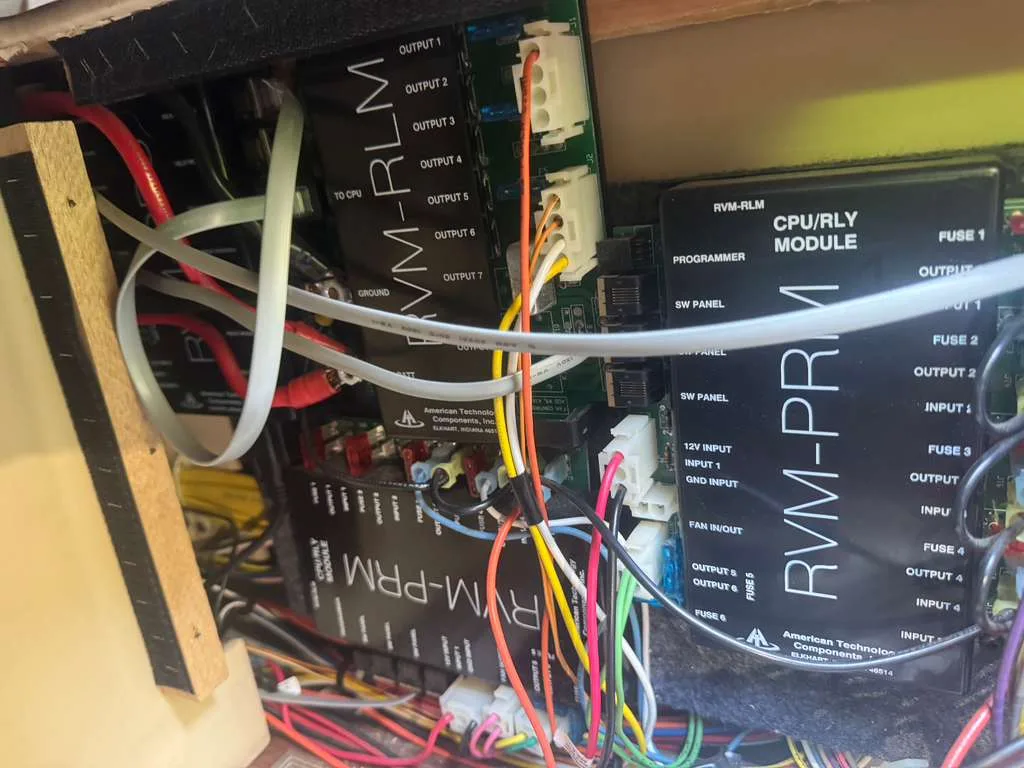
Work out whether the dead item runs on 120 volts or 12 volts, and half the possibilities disappear immediately.
The 120 volt side feeds the outlets, the air conditioner, the microwave and the converter. It comes from the shore cord or the generator through a transfer switch and a breaker panel. If those items are dead and the lights still work, the fault is on that side and nowhere else.
The 12 volt side feeds the lights, the water pump, the furnace fan, the slide motors and most controls. It comes from the batteries, topped up by the converter. If the lights are dim and the pump is slow while the outlets work, the fault is there.
The two meet at the converter, which is why a failed converter presents as a 12 volt problem on a coach whose 120 volt side is perfectly healthy. That single distinction resolves a great many calls before anyone opens a panel.
Why is a loose connection the most common fault?
Because everything in a coach vibrates for thousands of miles, and electrical connections are the parts least tolerant of that.
A terminal that is a fraction loose still conducts, so nothing appears wrong. It also has resistance, and resistance under load makes heat. Heat oxidizes the contact surface, which raises resistance further, and the process accelerates quietly until something discolors or melts.
That is why so many electrical faults present as intermittent before they present as dead, and why they often appear after a long drive rather than during one.
Ground connections are the worst offenders because a poor ground drops voltage without blowing anything. A slide motor that stalls, a pump that runs slowly and a light that dims under load can all be one corroded ground strap rather than three separate faults. Checking and cleaning grounds is genuinely the highest-value hour on this list.
What does a burnt shore power cord mean?
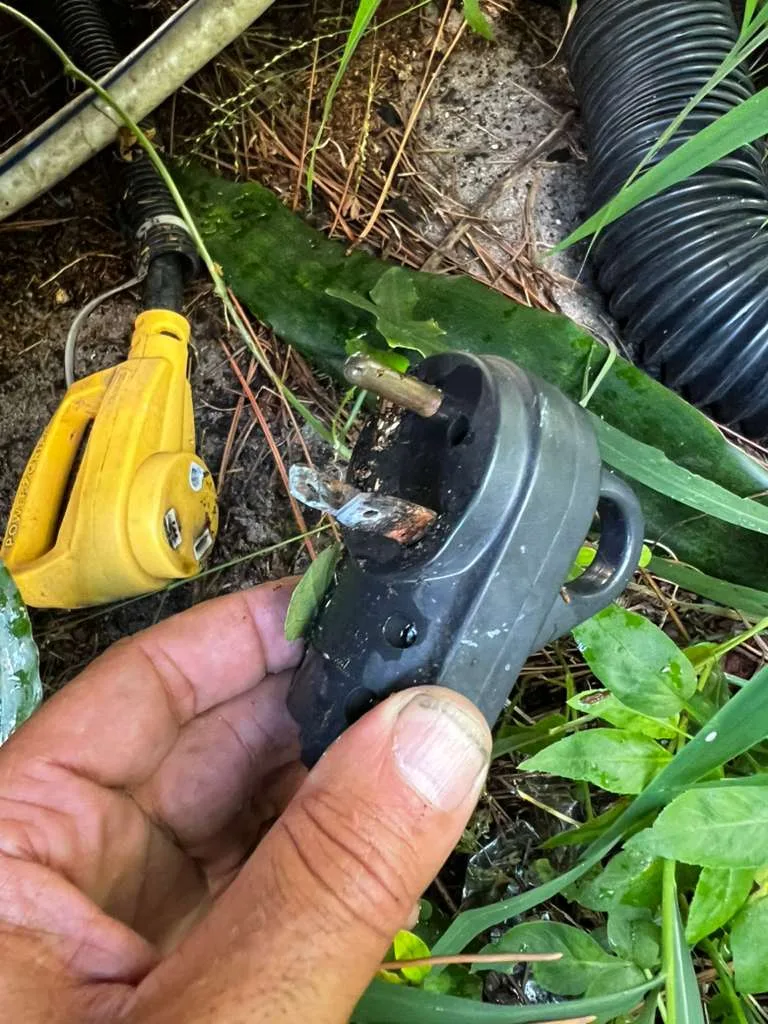
That a high-current connection was loose or corroded long enough to overheat, and that both halves of it are now suspect.
The plug and the inlet form one connection. Once one side has run hot enough to discolor or melt, the other side has been exposed to the same heat and its contacts have annealed. Replacing only the cord puts a new end into a damaged socket and the problem returns.
The cause is almost never the campground. It is usually an adapter stack, a cord not pushed fully home, or a connection that was already tired and finally arced under an air conditioner starting.
A cord that is merely warm to the touch is on the same path and should be dealt with before it melts. Our safety guide covers what to check without opening anything.
How do you tell a bad converter from a bad battery?
By what the voltage does when shore power is connected and disconnected, which separates the two in about a minute.
With shore power connected the converter should be holding the battery bank at a charging voltage clearly above resting. If it sits at resting voltage or below, the converter is not charging, and the batteries are being blamed for its failure.
With shore power removed, a healthy bank holds its voltage under a modest load and a failed one collapses quickly. That is a different measurement and it is the one that condemns a battery.
The confusing case is a coach that works perfectly on shore power and dies overnight. That is a battery or a parasitic draw, not a converter, because the converter was doing its job the whole time it was connected.
Is a lithium battery upgrade worth doing?
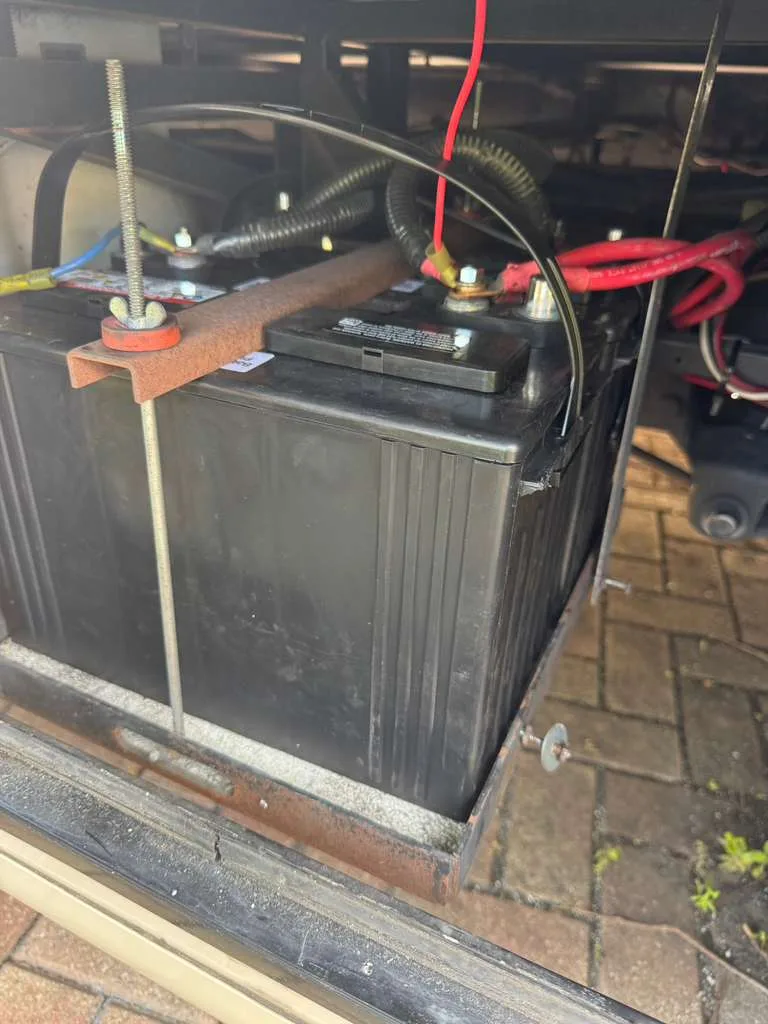
For most coaches yes, provided it is treated as a system change rather than as swapping one box for another.
Lithium gives far more usable capacity for the same weight, takes a much higher charge current and does not mind being cycled deeply. On a coach that boondocks, runs an inverter, or has converted to a residential refrigerator, the difference is substantial.
What it needs in exchange is a charging profile designed for it. An older converter set for lead-acid either undercharges lithium permanently or holds it at a voltage it should not sit at, and the alternator side needs a proper charger rather than a direct connection.
Cable sizing matters too, because the higher currents lithium accepts will heat undersized wiring that was adequate before. Done properly it is an excellent upgrade; done as a straight swap it disappoints.
Why do the batteries go flat when the coach is stored?
Because something is still drawing from them, and on a modern coach a great many things are.
Propane and carbon monoxide detectors, the radio memory, the control panel, the antenna booster, the refrigerator control board and any tracker all draw continuously. Individually each is small; together over weeks they will flatten a bank, and a lead-acid bank left flat sulfates and loses capacity permanently.
The battery disconnect switch fitted to most coaches does not always cut everything, which is why owners who think they have isolated the bank still come back to a dead one.
The diagnosis is a current measurement with everything switched off, then pulling fuses one at a time until the draw falls. It is methodical rather than clever, and it finds the circuit rather than guessing at it. A maintainer or a modest solar panel removes the problem entirely and costs less than one replacement bank.
What does Florida do to RV electrical systems?
Corrosion from the coast, heat on the connections, and lightning on top of both.
Salt air reaches every terminal in an underbody bay on a coach kept anywhere near either coast, and corroded terminals are exactly the loose-connection problem described above with a head start.
Heat is the second. Ambient temperatures in the nineties mean connections that would run warm elsewhere run hot here, and the same heat shortens battery life independently of how the bank is used.
The third is surge. This state has more lightning than anywhere else in the country and campground supplies are not always clean. A surge protector at the pedestal is inexpensive insurance for a coach full of control boards, and an energy management system also protects against the low voltage that damages compressors. None of the three is dramatic on any given day, which is exactly why they are usually found late.
What is safe to check yourself?
Anything on the 12 volt side with the shore cord unplugged, and nothing on the 120 volt side while it is live.
Battery voltage, terminal tightness, ground straps, fuses and the battery disconnect are all reasonable owner checks. So is looking at the shore cord and inlet for discoloration, which needs no tools at all and finds a genuinely dangerous condition.
What is not an owner job is anything inside the breaker panel, the transfer switch or the converter while a supply is connected. Those carry mains voltage in a confined space, often standing on damp ground, and that combination is where people get hurt.
If a smell of hot plastic is involved anywhere, the answer is to disconnect both supplies and stop. Our generator service covers the same rule on the supply side.
What Does Mobile RV Electrical Repair Cost?
These are typical ranges for mobile service across Florida. A brief description of what's included is in the Notes column.
| Service | Typical Range | Notes |
|---|---|---|
| Service call (trip + 1st hour diagnosis/labor) | $299 - $399 | All-in for getting us to your site + first hour on any job. Exact rate confirmed at booking; varies by location. |
| Battery replacement (single house) | $185 - $420 | AGM / lithium uplift priced separately |
| Battery bank (2-4 AGM) | $450 - $1,200 | Includes cables, fusing, and load test |
| Shore power cord / 30A receptacle | $120 - $310 | Pedestal-side diagnosis + pigtail if needed |
| Converter / charger replacement | $250 - $680 | WFCO or Progressive Dynamics; wired in |
| Solar charge controller | $180 - $520 | MPPT wiring and programming |
| Inverter installation | $350 - $1,100 | Includes cable run and distribution wiring |
| Circuit trace and repair | $95 - $275 | Breaker, fuse, or wire fault; per circuit |
| Slide-out motor / electrical | $220 - $680 | Electrical component; see slide-out service for mechanical |
Service call (trip charge + first hour) is $299-$399 depending on location - confirmed when you book. Repair line items below are national averages for mobile service (2025 data) and represent labor + parts after the first hour. Call (888) 702-6880 for an exact quote.
Electrical questions RV owners ask us
Why do my lights dim when the water pump runs?
That is voltage drop under load, and it usually means a tired battery bank or a poor connection between the bank and the distribution point. A healthy system barely moves. It is worth checking before it becomes a slide that will not retract, which is the same fault with a bigger motor.
Do I need a surge protector at every campground?
In this state, yes. Pedestal supplies vary and lightning is common. The version worth having also monitors voltage, because sustained low voltage does more damage to air conditioners and refrigerators than a surge does and it does it invisibly.
Can I use a household extension cord for shore power?
No. A standard household cord is not rated for the sustained current a coach draws and it heats along its whole length rather than at one point. If a longer run is genuinely needed it has to be a properly rated RV extension of the correct gauge.
My breaker trips only when the AC starts. Is the breaker faulty?
Usually not - it is doing its job. The compressor's starting surge is several times its running draw, and anything that raises that surge, such as a weak capacitor or low supply voltage, pushes it over. A soft start device is the common fix.
How long do RV batteries last in Florida?
Less than the same batteries would last in a cooler climate, because heat accelerates their aging whether they are being used or not. Keeping them charged rather than cycled flat makes more difference than anything else, and a maintainer during storage is the single best habit.
Is it worth adding solar?
It is, particularly for a coach that spends time off hookups or sits in storage. A modest panel and a proper charge controller will hold a bank against the parasitic draws described above indefinitely, which solves the storage problem without anyone remembering to do anything.
Sources
- OSHA - electrical hazards - Background on working near energized conductors and why the 120 volt side is not an owner job.
- Magnum Energy - inverters and chargers - Documentation for inverter-chargers and the charging profiles a lithium upgrade requires.
- Xantrex - power conversion - Reference for converters, inverters and transfer behavior in RV installations.
- Renogy - batteries and solar - Documentation for lithium banks, charge controllers and the cable sizing they need.